Santoku vs Gyuto: Which One Should You Actually Buy?
Short version: if you learned to cook watching someone rock a chef’s knife against the board, buy the gyuto. If you cut by pressing straight down, buy the santoku.
That’s it. That’s the decision.
Santoku vs gyuto gets written up as a beginner-versus-advanced question, or a Japanese-versus-Western one, and it is neither. They are two blades shaped around two different hand motions, and you already have one of those motions. Buying against it means fighting your own habits every time you cook.
Here is what actually differs.
The profile is the whole story
Put the two knives on a board, edge down, and look at the line where the edge meets the wood.
A gyuto has a curved belly. The edge sweeps up toward the tip, so only part of it touches the board at any moment. That curve is what lets you keep the tip planted and rock the handle up and down — the motion most Western cooks learned first.
A santoku is much flatter. More of the edge contacts the board at once, and it comes to a blunt, dropped tip rather than a point. There is nothing to rock on. The knife wants you to lift it and push down.
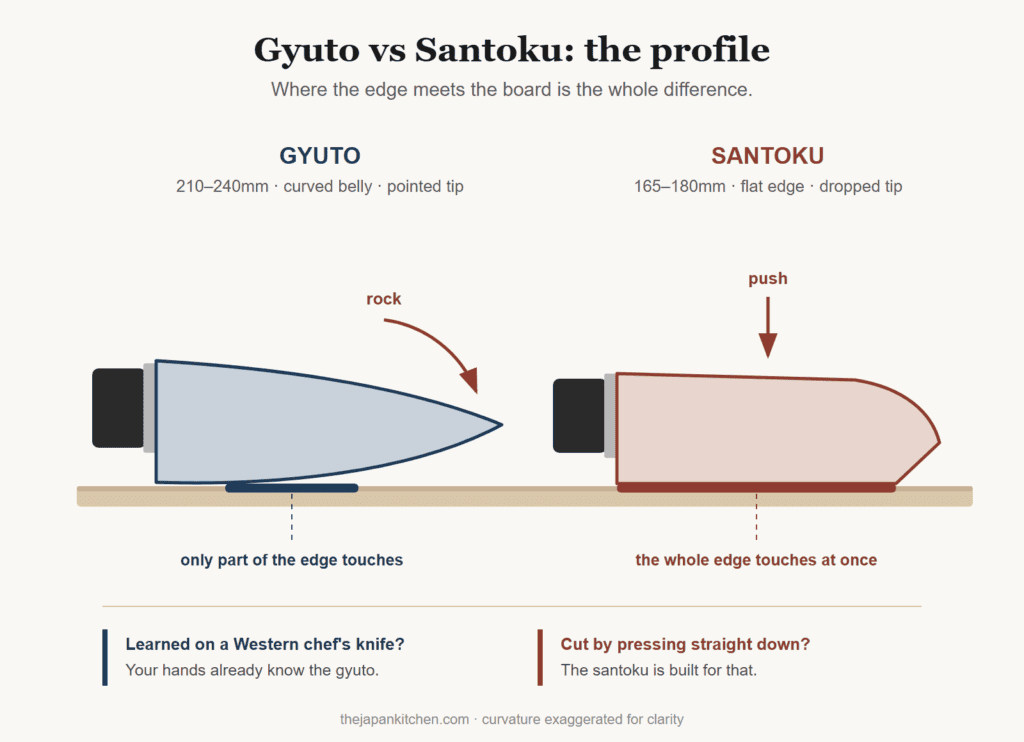
Everything else — length, weight, tip shape — follows from that one difference.
What each motion actually feels like
Rocking (gyuto). The tip stays down, the heel lifts, and you work through a pile of herbs or garlic by pivoting. It’s fast for fine mincing and it’s forgiving, because the curve means you’re never landing the whole edge at once.
Push cutting (santoku). You lift the blade clear and bring it straight down, then forward slightly. Each cut is a separate action. It’s cleaner through dense vegetables — a carrot, a daikon — because the flat edge meets the board along its whole length and nothing gets left connected at the bottom.
If you have ever finished slicing an onion and found the pieces still joined at one end, that’s a curved blade not reaching the board. A flatter profile fixes it.
Size
| Feature | Gyuto | Santoku |
|---|---|---|
| Typical length | 210–240mm | 165–180mm |
| Tip | Pointed | Blunt, dropped |
| Profile | Curved belly | Flat |
| Motion | Rock | Push |
| Board space needed | More | Less |
210mm is the standard gyuto and it is longer than people expect. On a small board in a small kitchen it becomes awkward — you run out of room on the backswing and start cutting at an angle. A 180mm santoku is a much easier knife to live with in a tight space.
The reverse is also true. If you regularly break down a whole cabbage or slice a large roast, a santoku is short enough that you’ll be sawing.
The tip
This is the underrated difference.
A gyuto’s point is genuinely useful: scoring skin, coring a tomato, separating a chicken thigh at the joint, getting into anything that needs precision. A santoku’s blunt tip cannot do any of that.
If you only own one knife, the pointed tip is worth something. If you already have a petty knife for small work, it matters much less — the petty does that job better than either of these.
Which one for which kitchen
| If you… | Buy |
|---|---|
| Learned on a Western chef’s knife | Gyuto — your hands already know it |
| Cook mostly vegetables | Santoku — the flat edge is better at it |
| Have a small board or a small kitchen | Santoku — 210mm needs room |
| Have small hands | Santoku — lighter and shorter |
| Own only one knife | Gyuto — the tip does more jobs |
| Already own a petty knife | Either — the tip advantage mostly disappears |
| Break down large cuts of meat | Gyuto — length matters |
| Want to try the Japanese motion | Santoku — it will teach you |
There is also a third option nobody mentions. A bunka is roughly santoku-sized with a flat profile and an angled, pointed tip — a reverse tanto shape. It gives you the santoku’s cutting behaviour and a usable point. If the tip is the only thing keeping you from a santoku, look at a bunka before you settle.
Shape is only the first of three decisions, and the other two — steel and construction — are covered in the full buyer’s guide.
What I own, and what that means for this article
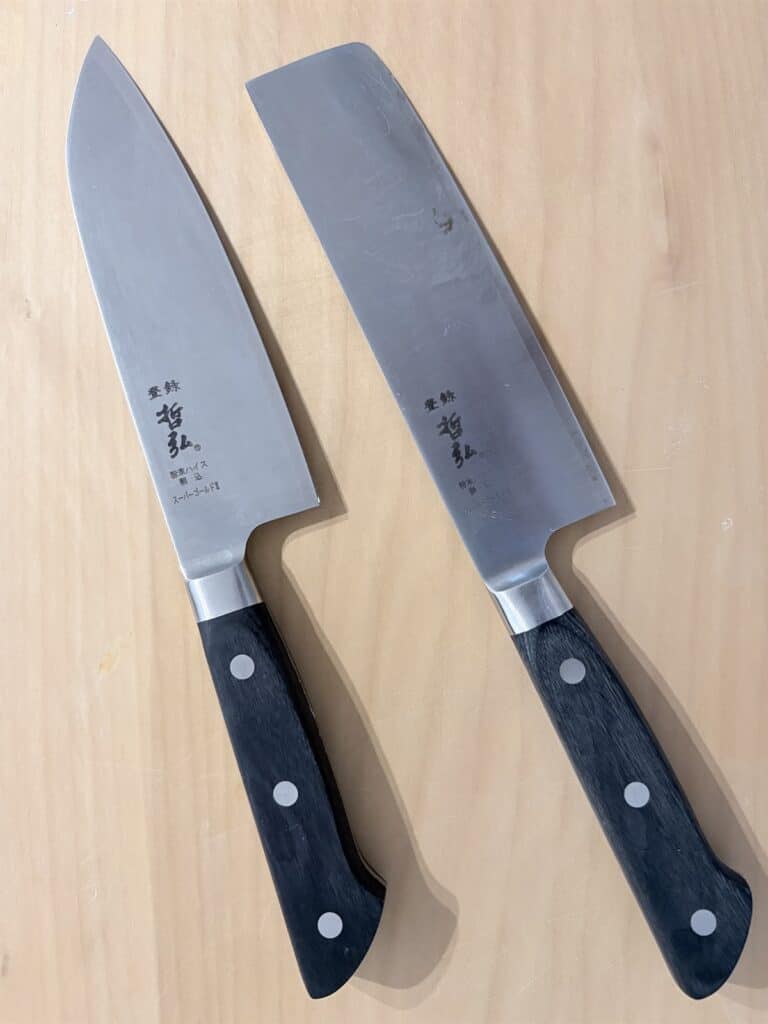
I own a santoku in SG2 — 160mm, from a workshop in Sanjo — and it is not the santoku I use most.

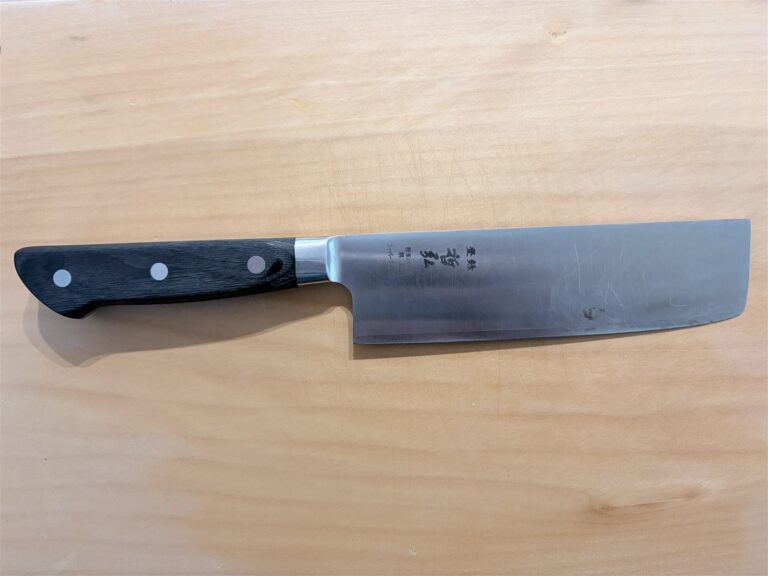
My everyday knife is a nakiri from the same maker, two years old, with the maker’s mark wearing off the blade face from handling. For general work I use a cheap stainless santoku. The SG2 one comes out for the cuts the cheap knife struggles with: thick chicken, skin, anything where a dull edge tears instead of slicing.
That division is worth mentioning because it complicates the usual advice. Buying the sharpest knife you can afford does not make it your default. Mine became a specialist.
I do not own a gyuto. So the gyuto side of this comparison is written from blade geometry and documented behaviour, not from cooking with one. I would rather say that than pretend otherwise.
What doesn’t matter
“Santoku means three virtues.” Meat, fish, and vegetables. It’s a nice name and it tells you nothing about whether the knife suits you.
“Gyuto means beef knife.” It’s the Japanese take on the Western chef’s knife, and the name is historical. It is not a meat specialist.
Which one is more Japanese. Both are. The gyuto is a Japanese interpretation of a Western shape, made by the same workshops, in the same steels, at the same hardness.
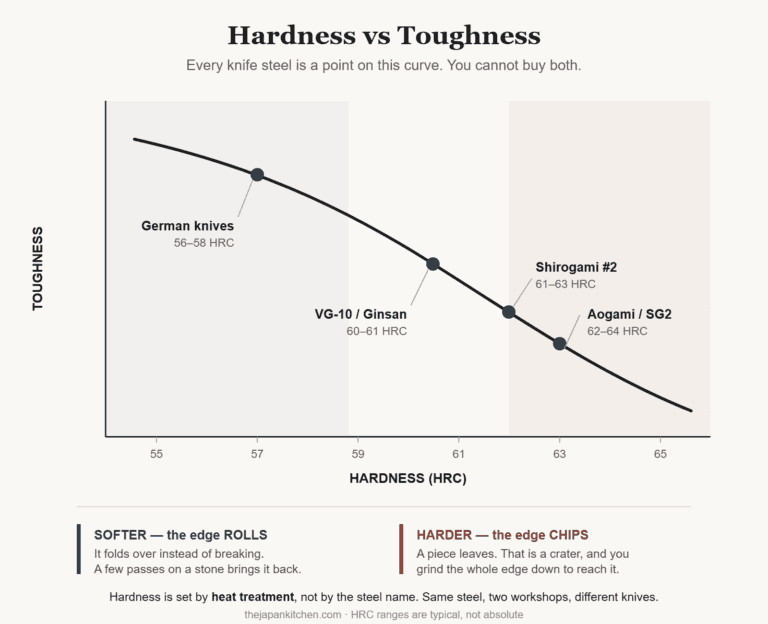
Steel type. It matters enormously for how the knife behaves — but it is a separate decision from shape, and you make it after this one. Japanese knife steel explained
Frequently asked
Can I rock a santoku?
Barely. The flat profile means the tip lifts off the board almost immediately. You can force it and you will hate it.
Is a santoku easier for a beginner?
It’s shorter and lighter, which helps. But “easier” depends on which motion you already have. A beginner with no habits can learn either.
Should I get both?
Eventually, maybe. Not at the same time. Buy one, use it for six months, and you’ll know precisely what the second one needs to be.
What about a nakiri?
A nakiri is a flat, rectangular vegetable knife — like a santoku with the profile taken further and the tip removed entirely. Excellent at vegetables, genuinely bad at meat. It’s a third knife, not a first one.
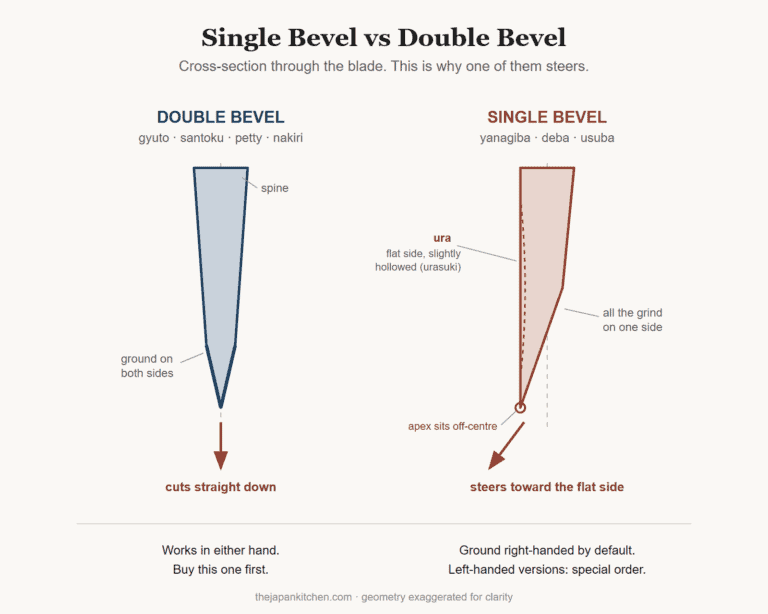
Are these single bevel or double bevel?
Both are double bevel, which is what you want. Single-bevel knives are specialists for fish and they steer sideways in general prep. The difference explained here
Related: Japanese Kitchen Knives: A Complete Buyer’s Guide · Japanese Knife Steel Explained · Single Bevel vs Double Bevel
Last updated: 16th August, 2026. Found something wrong? Tell me — corrections get published.