Single Bevel vs Double Bevel: What the Grind Actually Does
Short answer: buy double bevel. Almost certainly. Unless you’re breaking down whole fish or you already know why you want the other thing.
That’s not a dodge. Single bevel vs double bevel isn’t a beginner-to-advanced ladder, and the single-bevel knife isn’t the serious one. They’re different tools that fail in different ways, and one of them fails badly in an ordinary kitchen.
Here’s the geometry, and then what it costs you.
Single bevel vs double bevel: what the difference actually is
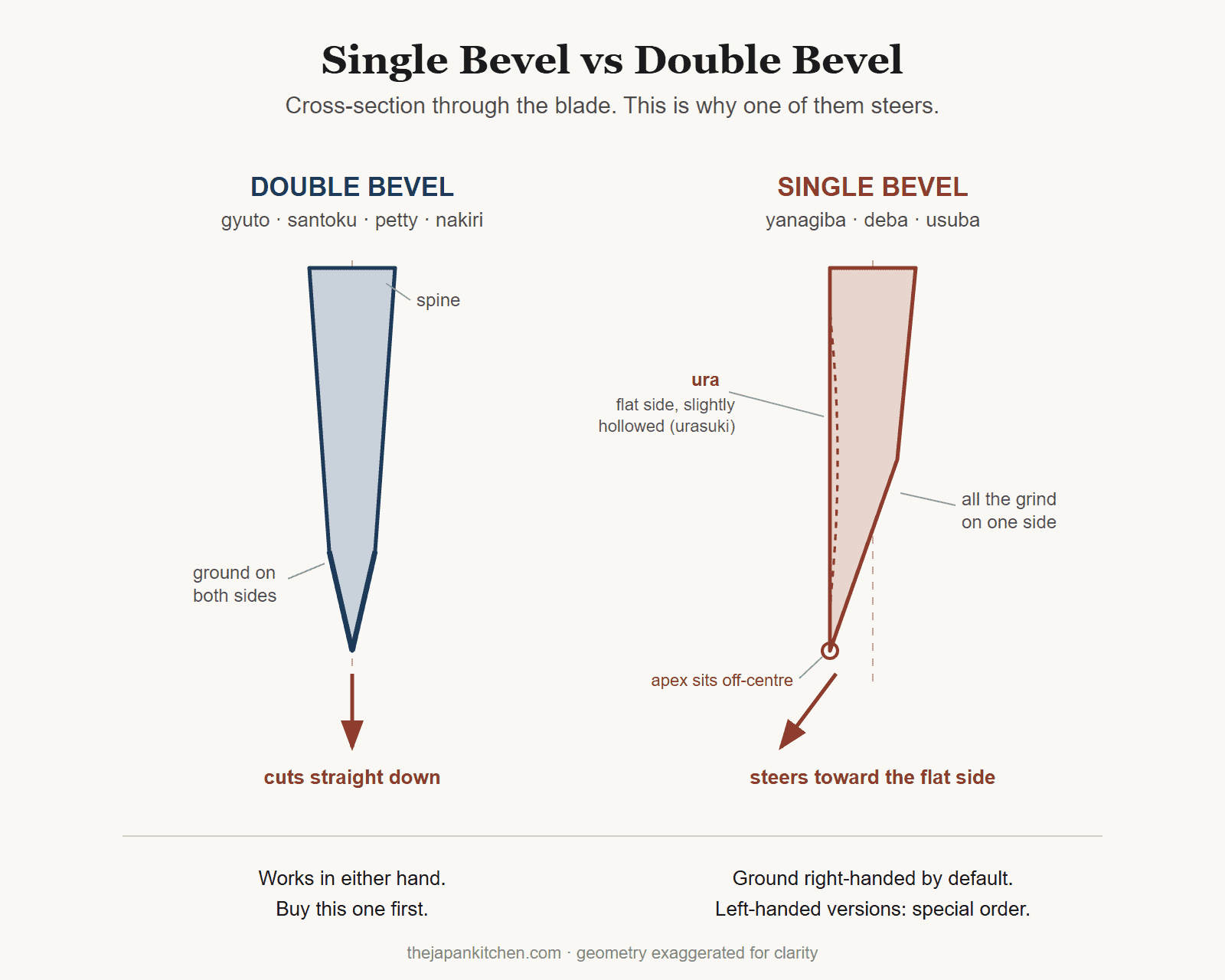
A double bevel knife — ryoba in Japanese — is ground on both sides. The two grinds meet at the centreline, so the edge sits in the middle of the blade, like a symmetrical wedge.
A single bevel knife — kataba — has all of its grind on one side. The other side is flat, usually with a shallow concave hollow called the urasuki. Because only one face is ground, the edge doesn’t sit at the centre. It sits off to one side.
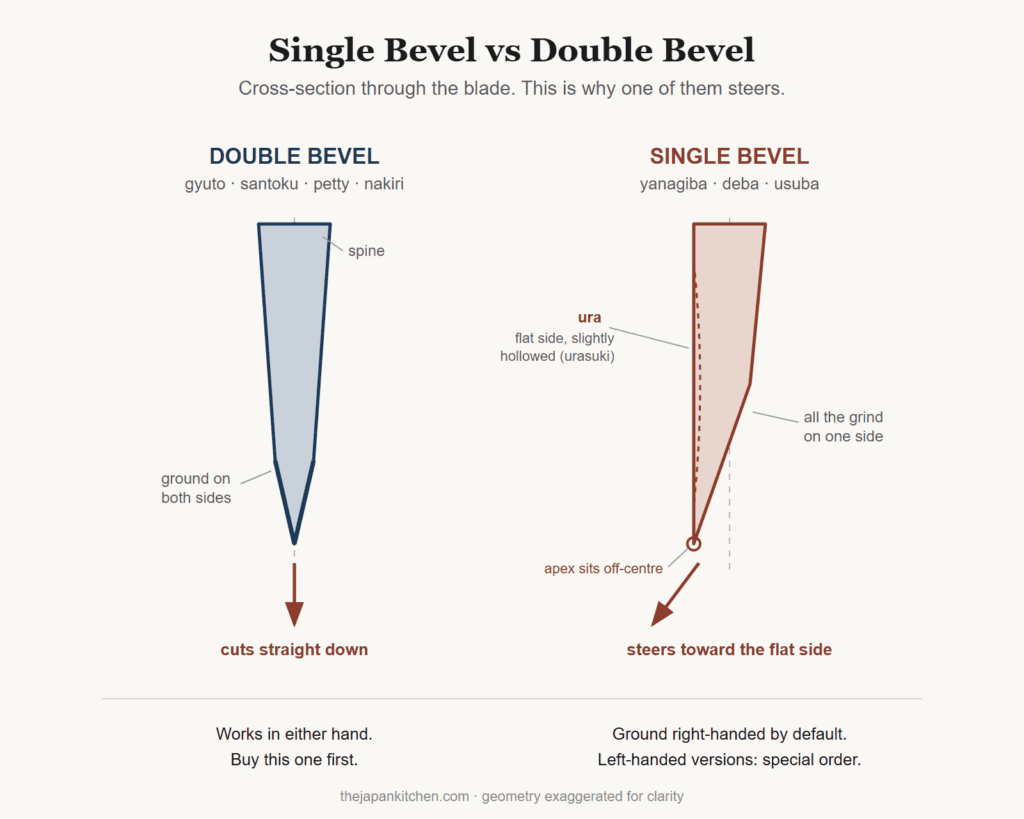
That offset is the whole story. Everything below follows from it.
Why a single bevel steers
Push a symmetrical wedge straight down and the material pushes back equally on both sides. The knife goes where you point it.
Push an asymmetrical wedge down and the forces don’t cancel. One face is doing all the work of separating the material, so the blade gets pushed toward the flat side. It wanders.
In fish, this is exactly what you want. A yanagiba drawn through sashimi produces one long clean face because the flat side leaves the slice alone while the ground side pushes the waste away. That release is why the knife exists.
Dicing an onion, it’s a problem. You aim straight down and the blade drifts, so your slices come out wedge-shaped and you spend the whole board fighting the knife back onto its line.
This isn’t a skill issue you can train away. Professionals who use single-bevel knives compensate for the steering on every cut, and they only bother because the payoff on fish is worth it. There’s no payoff on a carrot.
The handedness problem
This is the part that catches people out, and it’s the reason I put this article on the site.
Single bevel knives are ground for one hand. The standard is right-handed: bevel on the right side, flat on the left. A left-handed cook using a right-handed single bevel gets the steering effect working against them on every cut, plus the food release happening on the wrong side.
Left-handed versions exist. They’re usually made to order, cost more, and take longer.
Double bevel knives don’t have this problem. A gyuto, santoku, petty, or nakiri works the same in either hand.
Some double-bevel Japanese knives are ground slightly asymmetrically — 70/30 or 80/20 rather than 50/50 — to favour right-handed use. This is much milder than a true single bevel and most people never notice it, but it’s worth knowing the term exists if you’re left-handed and buying at the higher end.
Sharpening is a different job
On a double bevel you work both sides, roughly evenly, and if your angle wanders a little the knife forgives you.
On a single bevel you sharpen the bevel side normally — and then you have to maintain the flat side, which is where it gets specific. The urasuki hollow must stay hollow. If you flatten it by grinding the back, you’ve destroyed the geometry that makes the knife work, and getting it back is a job for a professional.
The correct move on the flat side is a light deburring pass, not sharpening. Learning where that line is takes time.
If you don’t already sharpen your knives, don’t start with a single bevel. More on stones and technique:
Which knives are which
| Double bevel | Single bevel |
|---|---|
| Gyuto — general purpose | Yanagiba — sashimi slicing |
| Santoku — general purpose, shorter | Deba — breaking down whole fish |
| Petty — small work | Usuba — vegetables, professional |
| Nakiri — vegetables | |
| Bunka — santoku with a pointed tip | |
| Sujihiki — slicing |
Notice the pattern. Every general-purpose Japanese kitchen knife is double bevel. The single-bevel knives are all specialists, and two of the three are for fish.
The usuba is the interesting exception — a single-bevel vegetable knife used in professional Japanese kitchens for techniques like katsuramuki, peeling a daikon into a continuous sheet. That’s a specific craft, not general prep.
Who should actually buy a single bevel
You break down whole fish regularly. A deba is genuinely the right tool and nothing else substitutes. Heavy spine, single grind, made to go through the collar bone.
You serve sashimi. A yanagiba produces a cut surface no double-bevel knife matches. If that matters to your food, it matters.
You’re training in a Japanese kitchen. Then someone is teaching you and this article isn’t where you’ll learn it.
You already own a good double bevel and want to go deeper. Fine. Buy the specialist as a third or fourth knife, after your main knife and a petty.
Everyone else: a double-bevel gyuto or santoku will do more of your work, better, with less resistance. Which knife to buy first
Frequently asked
Is single bevel sharper?
It can take a slightly finer edge, because all the grinding is concentrated on one side and the angle can be lower. But “sharper” stops mattering when the knife won’t go where you point it.
Can I use a single bevel for general cooking?
You can. You’ll fight it on anything thick, and your slices won’t be square. People do it. Most stop.
Can a left-handed person use a right-handed single bevel?
Physically yes, badly. The steering works against you and the food releases on the wrong side. Buy a left-handed one or buy double bevel.
How do I tell which one I’m looking at?
Look at the blade edge-on, pointing down. A double bevel narrows symmetrically to a centred edge. A single bevel has one flat face and one long grind, with the edge sitting off to one side. If a listing doesn’t say, ask before you buy — it’s not a detail you can fix afterwards.
Do double bevel knives ever steer?
Slightly, if the grind is asymmetric or uneven. Nothing like a single bevel. If a double-bevel knife pulls noticeably, it’s usually a sharpening problem, not geometry.
Related: Japanese Knife Steel Explained / Which knife to buy first
Last updated: 15th August, 2026. Found something wrong? Tell me and I’ll fix it with a note on what changed.