SG2 knife review: Tetsuhiro santoku and nakiri from Sanjo
There are no affiliate links in this review — I have no relationship with anyone who sells these knives. How this site makes money.
Most of what you will find searching for an SG2 knife review was written after a few weeks with the blade. Mine have been in the kitchen for two years.
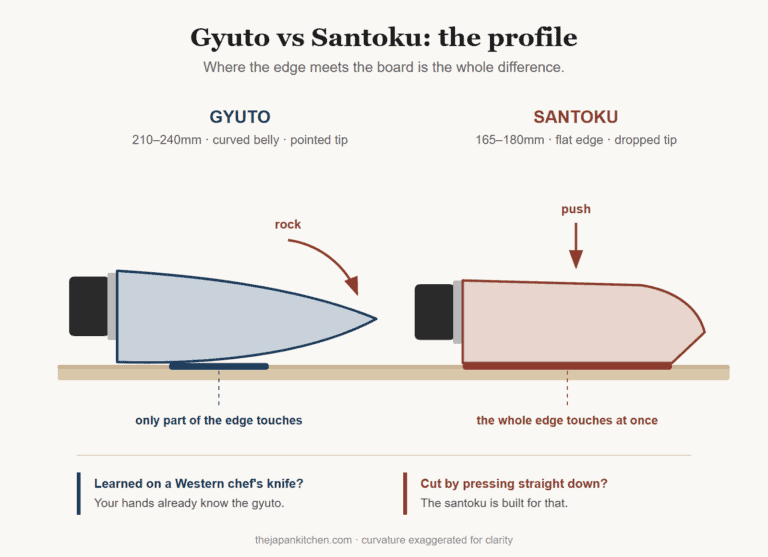
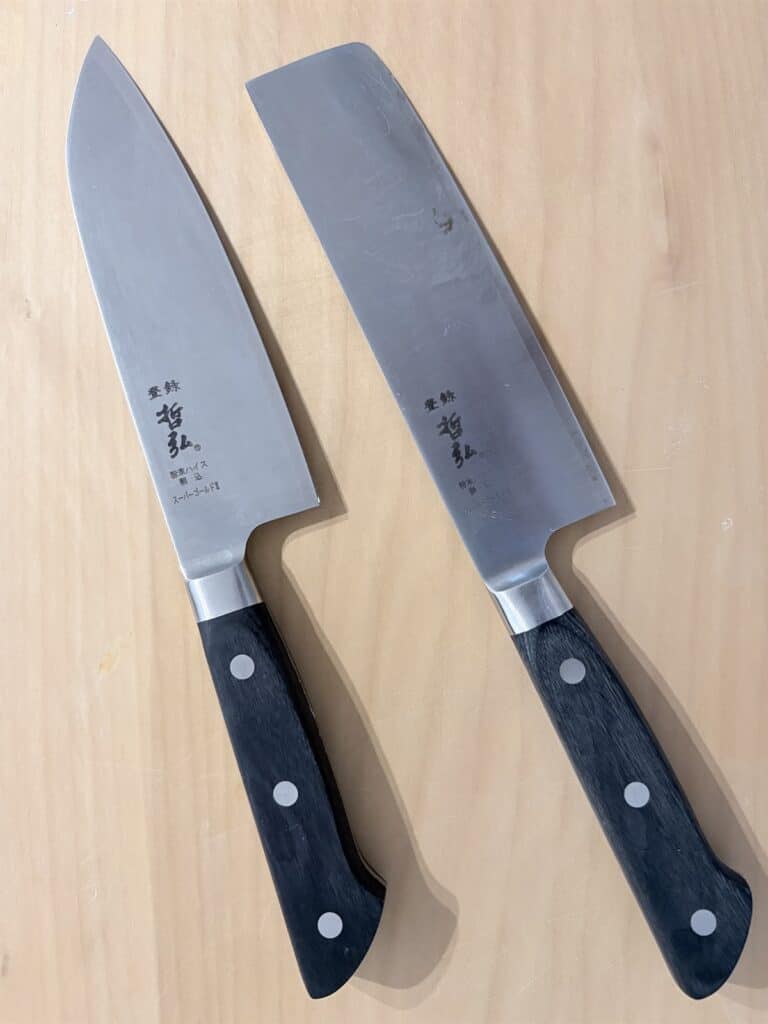
I have two of them — a 160mm santoku and a 160mm nakiri, both made by Kiryu Kogyo in Sanjo and sold under the Tetsuhiro name. In that time I have sharpened neither, used one almost every day, and barely touched the other. That imbalance turns out to be the most useful thing I can tell you about this steel.
One disclosure before anything else. These came to me through Japan’s hometown tax scheme rather than over a shop counter, so I did not pay the retail price. This site’s rule is that I buy what I review, and I want to be exact about the edge case: they were not a gift from the maker, but I cannot tell you whether they felt like good value at the till, because I was never at the till.
The short verdict
Would I buy these again? Yes — and I would buy the nakiri first.
Two years on one factory edge is not a marketing claim. It is a thing that happened in my kitchen, on a board I use every day, and it is the reason I would spend the money a second time.
But not for everyone, and I want to be exact about who. If you already sharpen on stones, cook often enough that edge retention is worth money to you, and hand-wash your knives, this is the steel — buy it and stop researching. If any one of those three is not true of you, the same knife will frustrate you, and there is a better first purchase.
The rest of this is the evidence for both halves of that.
What SG2 is, briefly
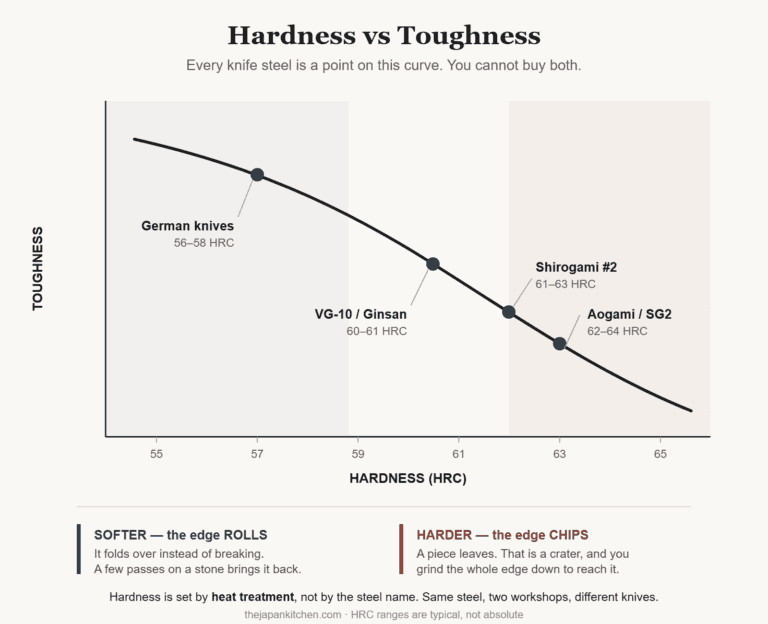
SG2 — also sold as R2 — is a powdered metallurgy stainless steel developed by Takefu Special Steel in Echizen and brought to market in 1991. Powdered production distributes the carbides more finely than conventional melting, which lets the steel reach high hardness without becoming as fragile as it otherwise would. It can be hardened to 64–65 HRC.
For context, most Japanese kitchen knives sit around 60–63 HRC and German knives around 56–58. SG2 is at the hard end of a category that is already hard. The full explanation of what that costs you is here.
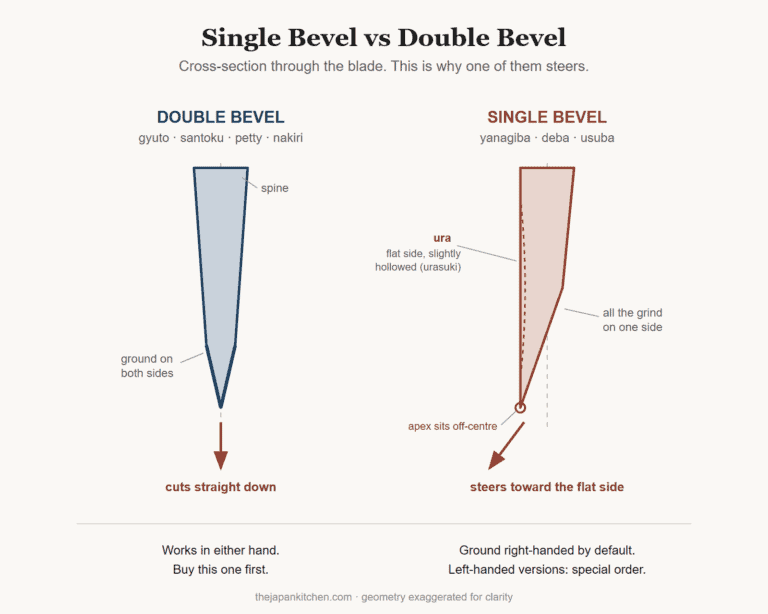
One thing worth clearing up, because product listings rarely do it. Neither of my knives is made of SG2 in the way a listing implies. The engraving on the blade says warikomi — laminated. There is a core of SG2 running down to the edge, and it is sandwiched between two outer layers of softer, more corrosion-resistant stainless. The part that cuts is SG2. The wide flat you actually look at is not.
This is normal construction at this price and it is not a compromise. Laminating a hard, brittle core into a softer jacket is how you get an edge this hard without a blade that snaps. But it changes what you should expect from the surface, and I will come back to it.
Kiryu Kogyo started in Sanjo in 1927 as Kiryu Seisakusho, and by the company’s own account was the first workshop in the Niigata region to put a stainless kitchen knife into production, in the late 1950s. It is still there.
The nakiri: two years, no sharpening
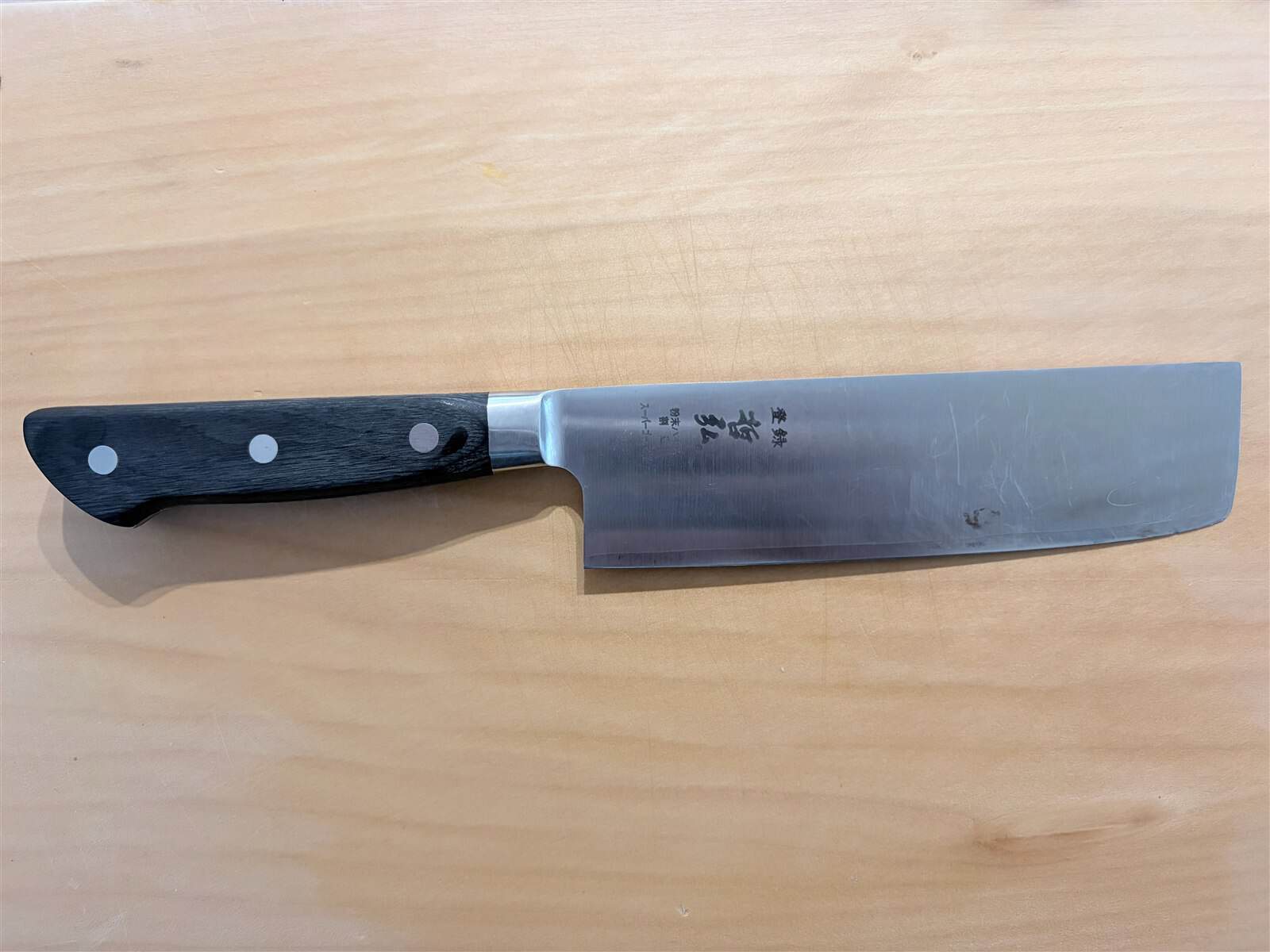
This is the knife that does the work. Vegetables, most days, on a ginkgo board.
It is only now starting to feel dull. Two years on one factory edge.
That number is the entire argument for powdered steel, and it is worth pausing on because forums will tell you something different. The common advice is that a good knife needs stropping or sharpening within about three months or it will feel dull. That has not been my experience, and I do not think either figure is wrong — it depends on what you cut, how often, and what you cut it on. A softer edge on a harder board would not have lasted this long.
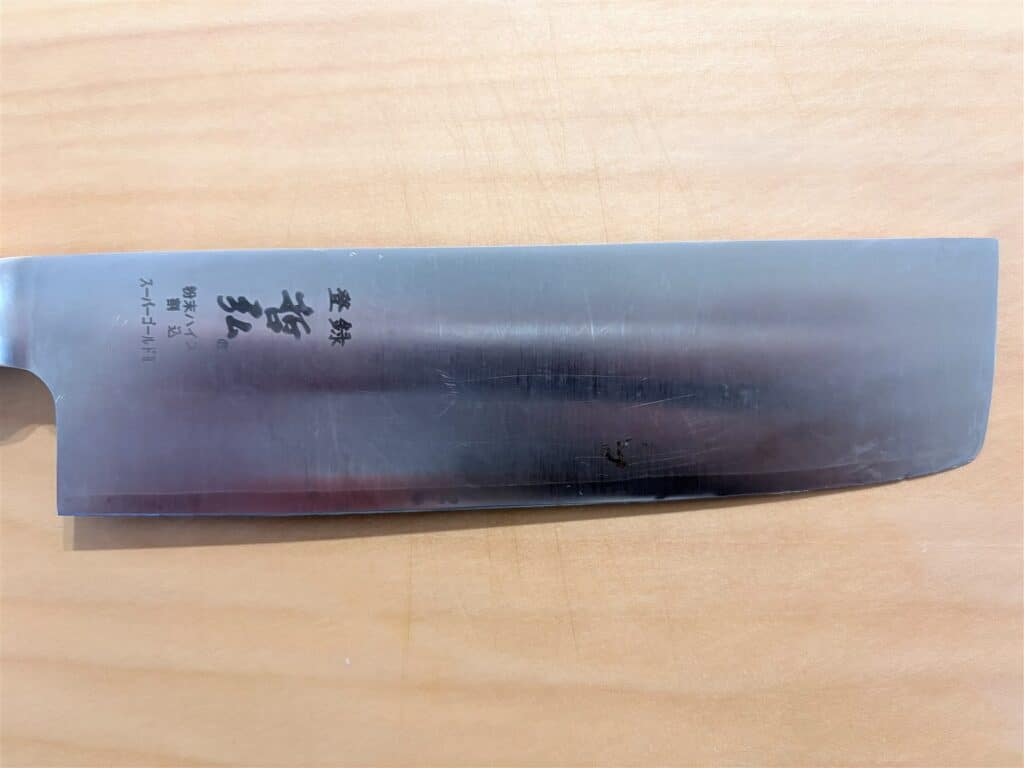
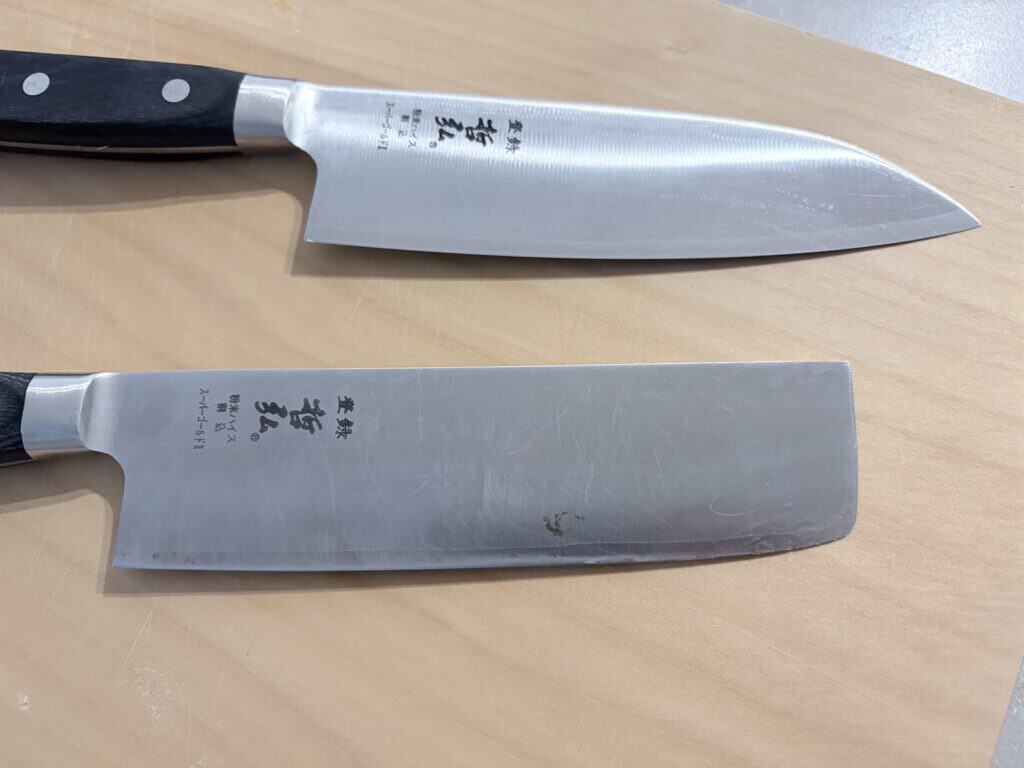
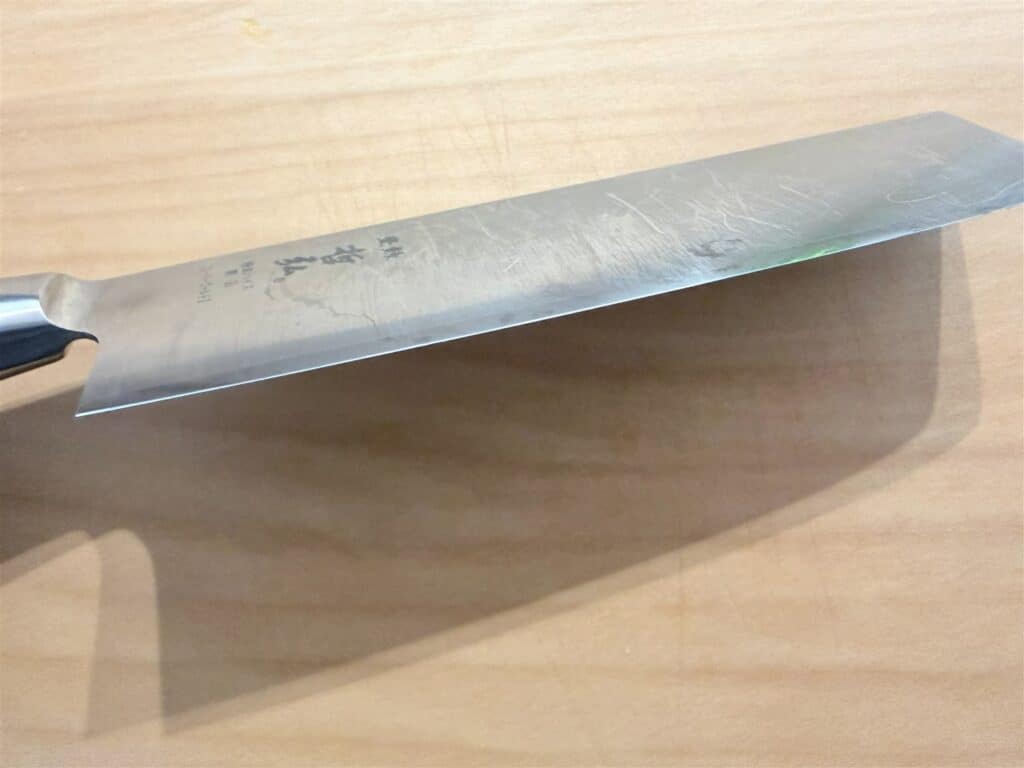
What the knife looks like now. Parts of the maker’s mark have gone faint. Not evenly, and not where you would predict — the thinning does not line up with where my hand sits on the blade, so I cannot honestly tell you what caused it. Most of the engraving is still perfectly legible at two years. There are fine scratches all over the flat. And there is staining, which brings me back to the lamination.
Stainless resists corrosion. It does not prevent it. And the wide face picking up these marks is not the SG2 at all — it is the softer jacket, doing the job it was chosen for. Leave the knife in the sink with acidic residue on it and you get spotting. Mine has. It is cosmetic rather than structural, and it is a fair record of how carefully I have actually treated the knife rather than how carefully I intended to.
The complication: I still have not sharpened it
Two years of not thinking about the edge sounds unambiguously good. Here is the other half.
I know SG2 is slow on a stone. I know it is unforgiving of a wandering angle and that it wants decent stones rather than whatever is in the drawer. And knowing that has made me postpone the job, week after week, for longer than I would like to admit.
So the honest description of this steel is not “it stays sharp.” It is: a long stretch of not thinking about the edge, followed by a sharpening session you keep putting off.
If you already sharpen well, that second half costs you nothing. If you do not sharpen at all yet, understand that SG2 is a poor steel to learn on — it will punish an inconsistent angle and take a long time doing it.
The santoku: why it still looks new
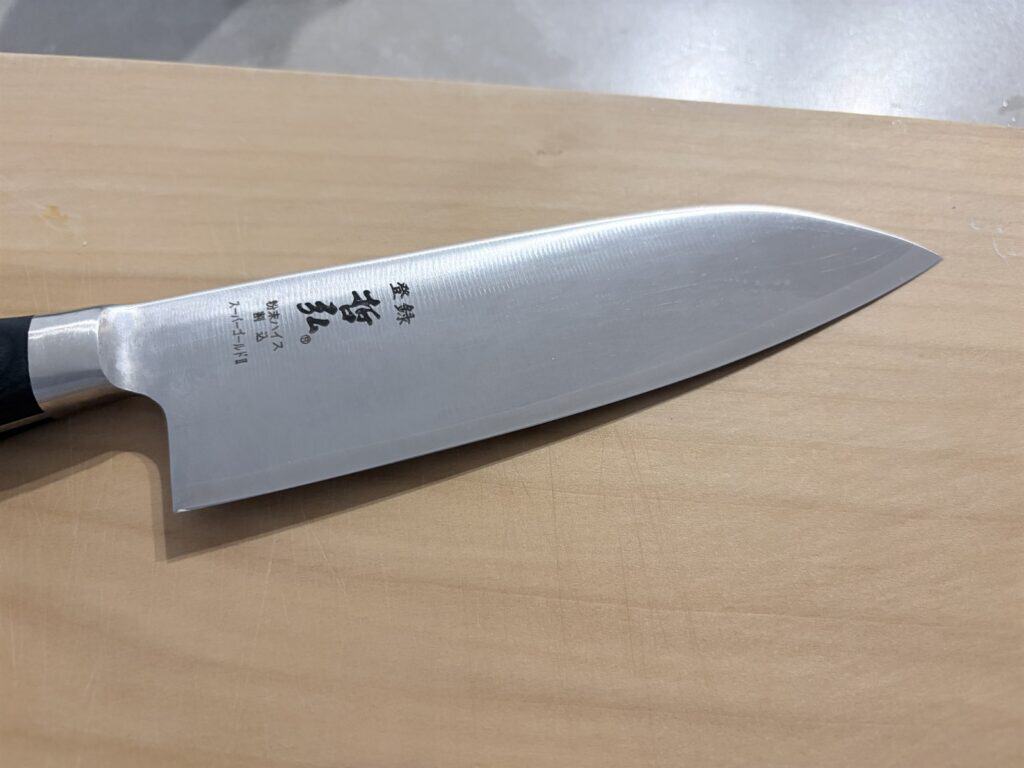
Same maker, same steel, same two years. It looks almost new, and the reason is more ordinary than you might expect.
The first reason is washing up. I own several santoku. When a job takes thirty seconds — halving a tomato, trimming one spring onion — reaching for the good one means hand-washing and drying it afterwards. The maintenance costs more time than the task did. So I take whatever is nearest, and the Tetsuhiro comes out for the cuts that actually need it: thick chicken, skin, anything where a dull edge tears rather than slices.
The second reason is deliberate. A knife doing fewer jobs stays sharp for longer. Reserving it is part of how I keep it in the state I want it in.
Neither of these is in any product description, and both are worth knowing before you spend the money. A premium Japanese knife arrives with a washing ritual attached, and that ritual is why you will not use it for everything. If you were picturing one knife that handles every job in your kitchen, the maintenance requirement quietly argues against it — not because the knife cannot do the work, but because you will not want to clean it four times in an evening.
The useful version of the lesson: the best steel you can afford does not automatically become your default knife. It may become the one you reach for when the job deserves it. That is a good outcome. It is just not what “everyday workhorse” implies on a product page.
The part nobody puts in an SG2 knife review
The nakiri has cut me. More than once, in the first months.
Not through slipping, and not through bad technique. A blade that passes through a carrot with no resistance passes through the side of a finger the same way, and there is no moment of feedback where you notice and stop. You notice afterwards.
The standard line is that a sharp knife is safer than a dull one. That is true about force — you push less, so the blade wanders less and slips less. It is not true about consequences. Both halves are real and only the first one ever gets said.
If you are moving to a high-hardness Japanese knife from a European one, budget a few weeks of deliberately slowing down.
Where SG2 sits against the alternatives
If you are choosing between the three steels a buyer at this level actually considers, here is how they compare.
| VG-10 | Aogami #2 | SG2 | |
|---|---|---|---|
| Typical hardness | 60–61 HRC | 62–64 HRC | 63–64 HRC |
| Edge retention | Good | Very good | Excellent |
| Ease of sharpening | Moderate | Moderate | Slow |
| Rusts? | No | Yes | No |
| Chip resistance | Better | Lower | Lower |
| Sharpening skill needed | Low | Medium | High |
Choose VG-10 if this is your first Japanese knife. It does nothing badly and it forgives you.
Choose Aogami #2 if you want the finest edge available and you will dry the blade every single time. It rusts. That is not a warning, it is a fact about the steel.
Choose SG2 if you want to sharpen as rarely as possible and you already know how. That is the trade it makes, and mine has honoured it.
More on all three: Japanese Knife Steel Explained
Who should buy SG2
Buy it if all three are true of you:
- You already sharpen on stones. Not “intend to” — already do, and can hold an angle without thinking about it.
- You cook most days. Two years of retention is worth real money to someone who prepares food daily and worth almost nothing to someone who cooks at weekends.
- You hand-wash and use a wood or soft plastic board. This is not a preference. At 64 HRC the edge chips rather than rolls.
If that is you, this is one of the few steels that genuinely delivers what the marketing says, and I would buy it again without hesitating.
Do not buy it if:
- This would be your first Japanese knife — start somewhere more forgiving
- You have never used a whetstone. SG2 is a bad steel to learn on and an expensive one to learn on badly
- Anyone in the house treats knives casually. A chip means grinding the whole edge down to reach it. The full list of ways to ruin one is here.
On the Tetsuhiro specifically
I cannot compare these against other SG2 knives, because these are the only two I own. What I can say is that after two years the fit is still tight, the handle has not loosened, and nothing has chipped — and given how the nakiri has been used, something would have by now if the heat treatment were poor.
The knives use Western-style riveted handles rather than the lighter Japanese wa style. That is a preference thing and I have no basis to compare, since I have never owned a wa-handled knife.
Where to buy, and which Tetsuhiro you will actually find
Tetsuhiro is not a brand you will trip over in a Western shop, and the version of it you find is usually not the version I own. Here is what I could actually verify in August 2026.
The exact knives. Okawari Shoukai, a Japan-based shop that ships internationally and prices in USD, lists both the SG2 nakiri and the SG2 santoku at 160mm for $105 each. That is the closest thing to “the knife in these photographs” available to a reader outside Japan, and it is close to the domestic price — around ¥16,000 here.
A different Tetsuhiro line. Knifewear in Canada carries the Kanko series: SG2 damascus, ebony handles, kiritsuke profiles, CAD $258 for a 135mm petty up to CAD $495 for a 270mm sujihiki. Same steel, same workshop, different knife. The edge retention I have described should carry over. The handling will not — an ebony handle and a kiritsuke tip are a different thing in the hand.
Amazon. There are Kiryu Kogyo listings on Amazon US, but the ones I found were VG-10 rather than SG2. Check the steel before you assume the model matches this review.
None of the above are affiliate links. I have no relationship with any of those shops and earn nothing if you buy. If that changes, this section changes, and the date at the bottom changes with it.
Frequently asked
Is SG2 better than VG-10?
It holds an edge longer. It is also harder to sharpen and more likely to chip. Whether that is “better” depends entirely on whether you sharpen and how carefully you cut.
Is SG2 the same as R2?
Effectively yes — they are the same class of powdered stainless, sold under different names. You will see both used interchangeably.
Does SG2 rust?
It is stainless, so not in the way carbon steel does. It will stain if you leave it wet with acidic residue. Mine has — on the softer outer layer rather than the SG2 core.
Is the whole blade SG2?
On a laminated knife like mine, no. The SG2 is a core running to the cutting edge, jacketed on both sides in softer stainless. Most knives sold as “SG2” at this price are built this way. It is worth knowing before you judge the surface.
Can a beginner use one?
Use, yes. Maintain, probably not yet. The steel is unforgiving on a stone and expensive to fix if you chip it.
How much does it cost?
I did not pay retail for mine, so I will not pretend to know what they feel like to buy. For scale: the 160mm SG2 nakiri and santoku sell for about $105 each from a Japan-based shop that ships abroad, and around ¥16,000 domestically. The dressier Kanko line runs several times that. Checked August 2026 — prices move, so treat those as a bracket rather than a quote.
Related: Japanese Knife Steel Explained · Japanese Kitchen Knives: A Complete Buyer’s Guide · Japanese Knife Regions
Last updated: August 17, 2026. Found something wrong? Tell me — corrections get published.