Japanese Knife Steel Explained: What the Name Actually Tells You
Every listing for a Japanese knife gives you a steel name. White #2. Aogami Super. VG-10. SG2. Japanese knife steel is presented like grades on a report card, as though there’s a ranking and the expensive one wins.
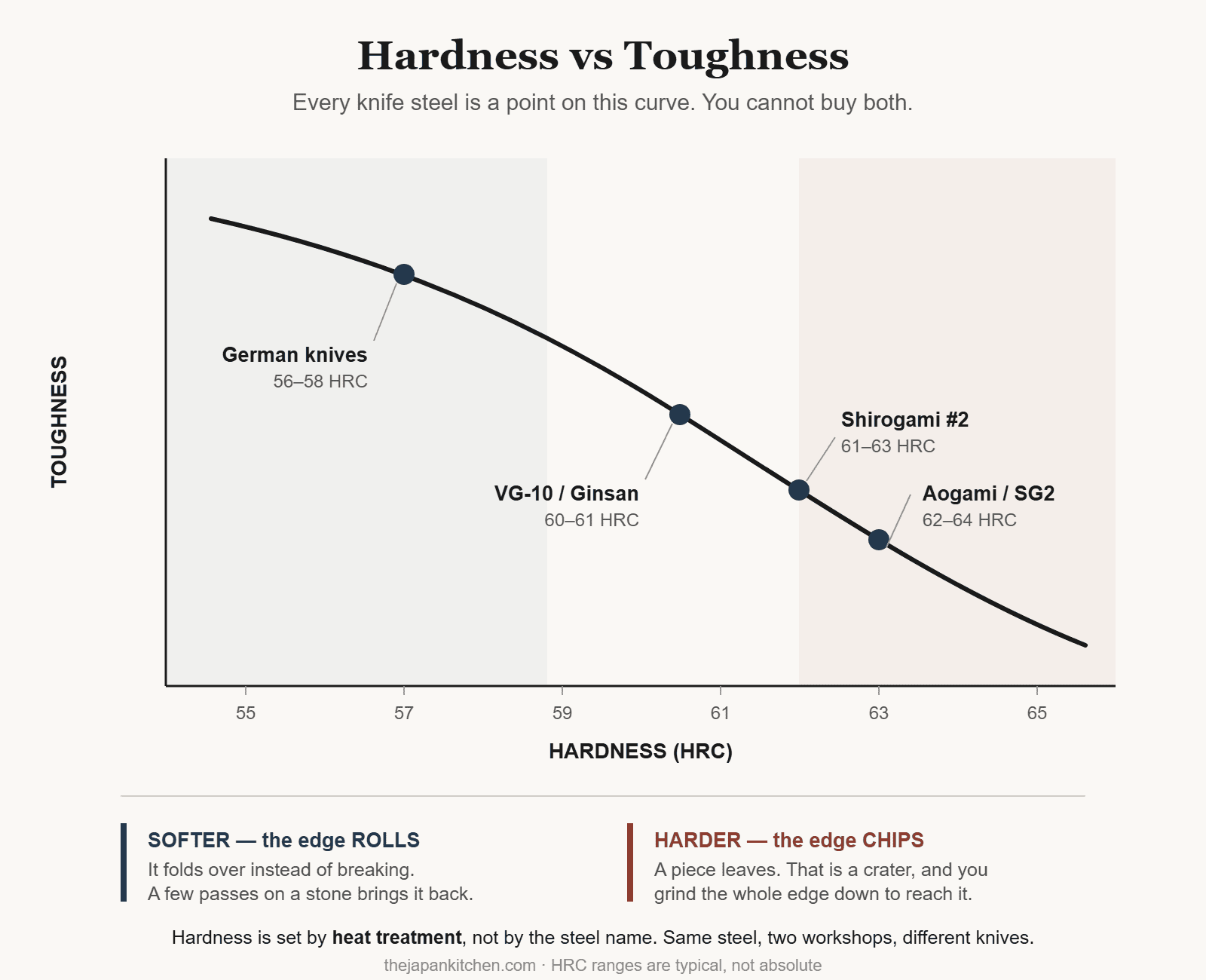
There isn’t a ranking. There’s a trade-off curve, and each of those names is a different point on it.
Once you see the curve, the whole category stops being confusing. Here it is.
The one thing all of this comes down to
Hardness and toughness are opposites, and you cannot buy both.
Hardness is resistance to deformation. A hard edge stays where you put it — the apex doesn’t fold over when it meets a carrot, so the knife keeps cutting cleanly for longer. That’s edge retention, and it’s what everybody wants.
But steel that will not bend has to break instead.
That’s not a manufacturing flaw. It’s the same property viewed from the other side. When a hard blade meets something it can’t cut — a chicken bone, a frozen edge, a ceramic plate, the corner of a glass board — the edge has no way to absorb that energy by deforming. So a piece of it leaves.
Softer steel does the opposite. The edge rolls over instead of chipping. It goes dull sooner, but it goes dull recoverably — a few passes on a stone and it’s back. A chip is a crater, and fixing it means grinding away metal until the whole edge reaches the bottom of the crater.
Every steel choice is a decision about which failure mode you’d rather have. Nobody selling a knife phrases it that way.
What HRC actually measures
You’ll see numbers like 61 HRC. That’s Rockwell C hardness, standardized as ASTM E18 — a diamond cone is pressed into the steel under a fixed load, and the depth of the dent is measured. Deeper dent, lower number.
Useful reference points:
| Knife type | Typical HRC |
|---|---|
| German / European kitchen knives | 56–58 |
| Most Japanese kitchen knives | 60–63 |
| High-hardness Japanese (powdered steels) | 63–65 |
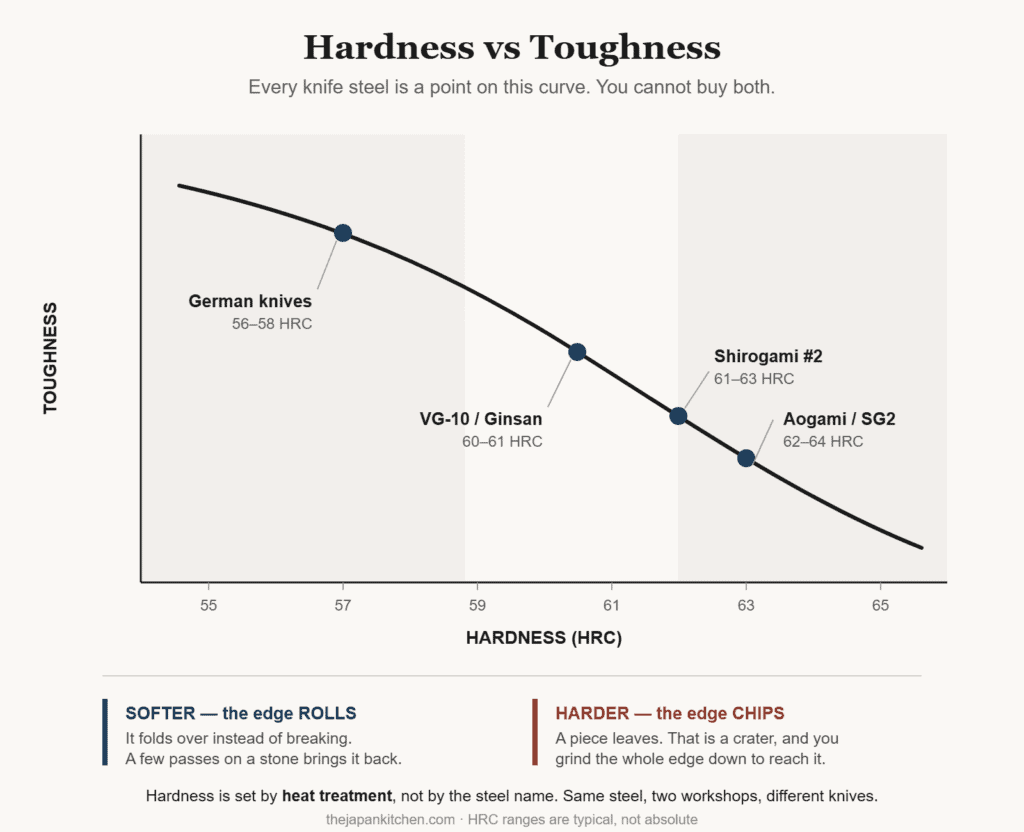
That gap — 57 versus 62 — is the entire behavioral difference between the two traditions, expressed as one number. Japanese knives hold an edge longer and tolerate abuse worse. It isn’t mysticism. It’s a heat treatment choice.
The part that matters more than the steel name
HRC is a result of heat treatment, not a property of the steel.
This is the single most useful thing on this page, and almost no product listing mentions it.
The same VG-10 can come out of one workshop at 60 HRC and another at 62. Same alloy, same chemistry, different hardening and tempering — and meaningfully different knives. A well-heat-treated budget steel will outperform a badly heat-treated premium one, every time.
Which means the steel name is a category, not a spec. It tells you roughly what the knife is capable of. It does not tell you whether this particular knife achieved it.
What actually predicts quality is the workshop. That’s why the regions matter more than the alloys: Japanese Knife Regions
Carbon or stainless: what the difference really is
Steel is iron plus carbon. Add enough chromium — roughly 10.5% or more — and you get a passive oxide layer that resists corrosion. That’s stainless.
The chromium isn’t free. It forms chromium carbides, which are hard particles distributed through the steel. They help wear resistance, and they also make the edge slightly less refined at the very apex and the steel more stubborn on a stone.
That’s the whole trade. Carbon steel takes a keener edge and sharpens faster. Stainless doesn’t rust.
“Stainless” does not mean “stain-proof.” It means it resists corrosion under normal use. Leave a stainless blade wet in a sink overnight with acidic food residue on it and you can still get pitting.
The Japanese knife steels you’ll actually encounter
Carbon steels
Shirogami (White Steel) — #1, #2, #3
High-purity carbon steel with almost nothing else added. The numbers are carbon content, descending: #1 highest, #3 lowest.
Both Shirogami and Aogami are made by Proterial — formerly Hitachi Metals — at the Yasugi works in Shimane prefecture. The names come from the colour of the paper the steel was wrapped in for shipping, which is a better origin story than most marketing departments could invent.
Because there’s so little alloying, the carbide structure is fine and uniform, which is why white steel takes the keenest edge of anything on this list and sharpens with the least effort. It also has the least wear resistance, so that beautiful edge doesn’t last as long. And it rusts fast — not “eventually,” but visibly within a day if left wet.
#2 is the sensible choice. #1 is harder and more brittle for a marginal gain most people can’t use. #3 is softer and more forgiving.
Aogami (Blue Steel) — #1, #2, Super
White steel with chromium and tungsten added. Those form harder carbides, so the edge lasts noticeably longer. In exchange it’s more work on a stone, and the ultimate sharpness is a hair below white.
Aogami Super adds more carbon plus vanadium and molybdenum. Excellent edge retention, meaningfully harder to sharpen. It’s a steel for someone who already sharpens well.
Blue steel still rusts. The chromium content is far below stainless territory.
Stainless steels
VG-10
The most common premium Japanese stainless. Around 60–61 HRC. It’s the safe middle: good edge retention, reasonable sharpening, widely available, no dramatic weakness.
Its honest drawback is that it isn’t excellent at anything. It’s the steel you recommend when you don’t know what someone needs — which is exactly why it’s the right first knife for most people.
Ginsan (Gin-3, Silver-3)
Stainless that behaves like carbon steel on a stone. Sharpens easily, takes a fine edge, doesn’t rust. Less common than VG-10 and often not marketed as hard, but for people who want carbon-steel sharpening behavior without carbon-steel maintenance, this is the answer nobody mentions.
SG2 / R2
SG2 was developed by Takefu Special Steel in Echizen and released in 1991. It can be hardened to 64–65 HRC.
Powder metallurgy stainless, typically 63–64 HRC. Powdered production distributes the carbides more finely and evenly than conventional melting, which lets the steel reach high hardness with better toughness than it otherwise would.
Outstanding edge retention. Also: brittle relative to softer steels, slow to sharpen, and it demands decent stones. This is not a beginner steel, regardless of price.
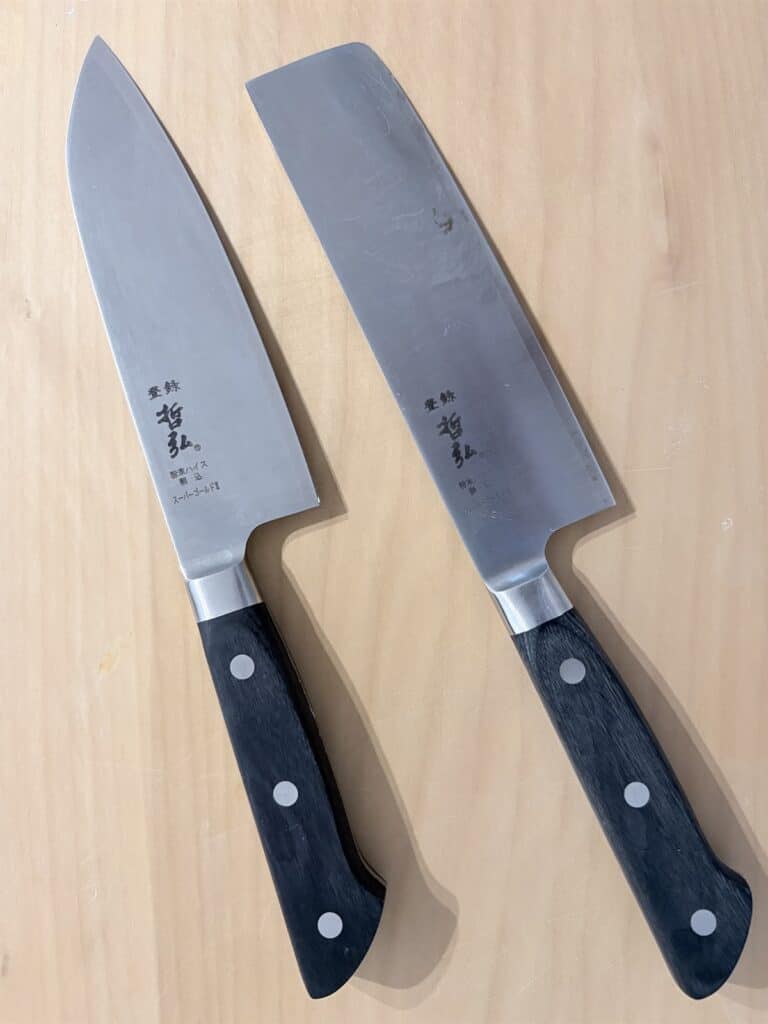
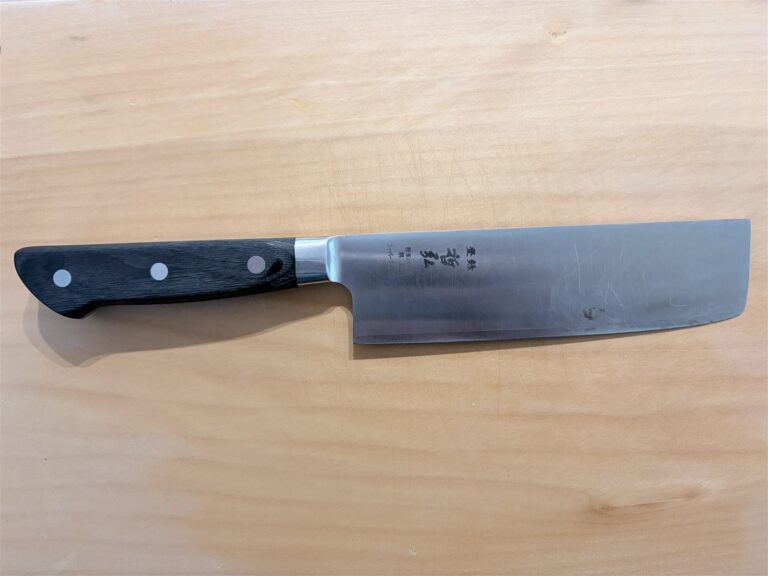
I own two SG2 knives — a santoku and a nakiri, both from a workshop in Sanjo — and they’ve been in daily use in my kitchen for a year. That year is worth describing, because it shows both halves of the trade.
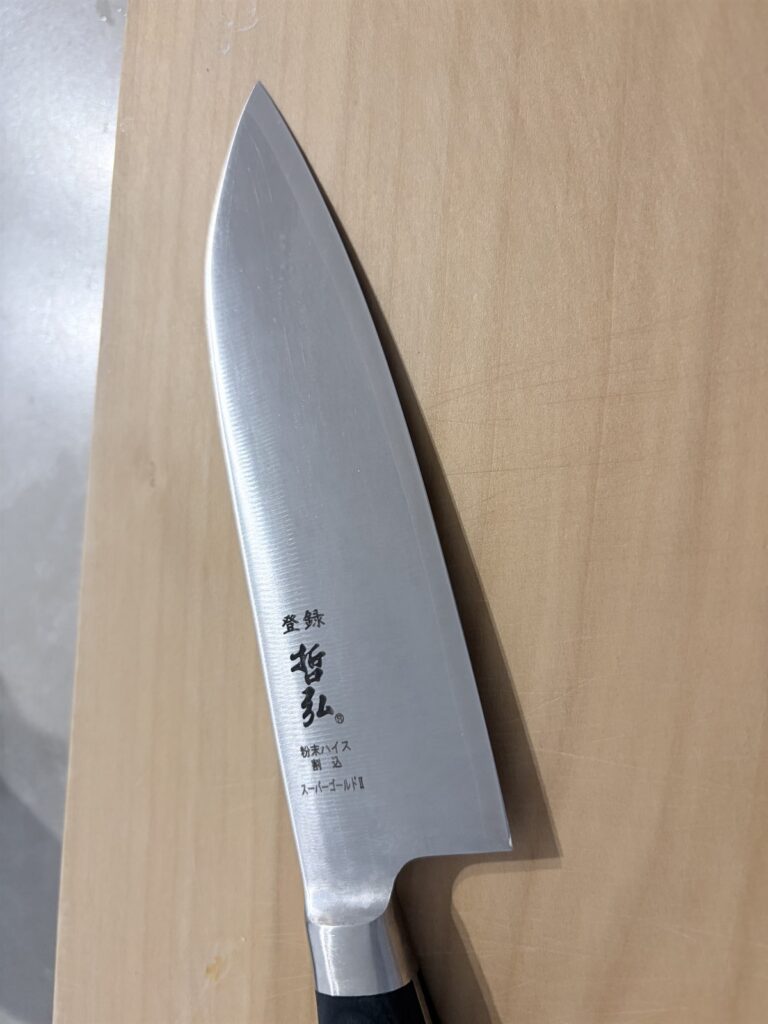
The mark reads “powdered high-speed steel, laminated, Super Gold II.”
The good half. The nakiri is only now starting to feel dull. Two years of household cooking on one edge is what “excellent edge retention” means when you stop reading spec sheets and start counting months. It is genuinely impressive, and it is what you are paying for.
The other half. I still haven’t sharpened it. I know SG2 is slow on a stone and unforgiving of a wandering angle, and knowing that has made me postpone the job week after week. So the honest description of this steel is: a year of not thinking about the edge, followed by a sharpening session you keep putting off.
If you don’t sharpen your own knives yet, that second half is the part to weigh.
One thing nobody warns you about
An edge this fine changes how much attention the knife demands. Mine has cut me — not through slipping or bad technique, but because a blade that passes through a carrot with no resistance passes through the side of a finger the same way. There is no moment of feedback where you notice and stop. You notice afterwards.
The standard line is that a sharp knife is safer than a dull one. That’s true about force: you push less, so the blade wanders less and slips less. It is not true about consequences. Both things are real, and only the first one gets said.
If you’re moving to a high-hardness Japanese knife from a European one, budget a few weeks of consciously slowing down. And keep plasters in the kitchen drawer.
AUS-8 / AUS-10
Budget stainless, softer at roughly 58–59 HRC. Dulls sooner, chips less, forgives more. Genuinely fine for someone who won’t sharpen often.
The steel name usually refers to the core only
Most Japanese knives are laminated. A hard steel core is forge-welded between softer outer layers — san-mai for three layers, kasumi in the traditional single-bevel construction.
When a listing says “VG-10,” it almost always means a VG-10 core with different steel cladding it. The cladding is usually softer stainless or soft iron. It does no cutting. It absorbs shock, makes the knife easier to sharpen, and holds the whole thing together.
Two consequences worth knowing:
Damascus patterning is in the cladding. The rippling pattern people pay extra for is layered soft steel wrapped around a core that does the actual work. A damascus VG-10 knife cuts exactly like a plain VG-10 knife with the same heat treatment. Buy the pattern because you like looking at it — that’s a completely reasonable thing to buy — but it isn’t performance.
A “stainless” knife with a carbon core is not stainless at the edge. Some knives clad carbon steel in stainless. The face won’t rust; the exposed edge will. This catches people out.
Which one should you get?
| If you… | Steel | Why |
|---|---|---|
| Are buying your first Japanese knife | VG-10 | No dramatic weaknesses. Hard to regret |
| Want carbon sharpening without the rust | Ginsan | Underrated, and the honest answer to that question |
| Will dry it every single time, without exception | Shirogami #2 | The finest edge available for the effort |
| Sharpen well and want the edge to last | Aogami #2 | Better retention, still sharpenable by hand |
| Share the kitchen with someone careless | AUS-8/10 | Chips less. Fewer arguments |
| Want maximum edge retention and own good stones | SG2 | Excellent, and unforgiving |
| Cut through bones or frozen food | None of these | You want a cleaver or a Western knife. Any of these will chip |
Four things that aren’t true
“Harder steel is better steel.”
Harder steel holds an edge longer and chips more easily. Whether that’s better depends entirely on how you cut and what your cutting board is made of.
“Damascus cuts better.”
The pattern is in the cladding. It’s decoration layered over the part that does the work.
“Japanese steel means made in Japan.”
Two separate claims. Steel can be imported and a knife assembled anywhere. If a listing says “Japanese steel” but never says “made in Japan,” notice the gap.
“Carbon steel is sharper than stainless.”
Carbon takes a keener apex and gets there faster. But a freshly sharpened VG-10 outcuts a neglected white steel blade every time. In practice, how often you sharpen matters more than what you sharpen.
Frequently asked
Does the steel name tell me the hardness?
Only approximately. Heat treatment sets the actual hardness, and it varies between workshops using the same steel. The name gives you a range, not a value.
Is more expensive steel worth it?
Up to a point. Moving from budget stainless to VG-10 or Ginsan is a real, felt improvement. Moving from VG-10 to SG2 buys edge retention at the cost of sharpening difficulty — worth it only if you already sharpen well.
Can I put a carbon steel knife in the dishwasher?
No. Nor a stainless Japanese knife. Heat, detergent, and knocking against other items will damage the edge and the handle. 7 Mistakes That Ruin a Japanese Knife
How do I stop carbon steel from rusting?
Wipe it dry immediately after every use. That’s most of it. A stable patina eventually forms and provides some protection — that process is worth understanding before it starts alarming you:
Related: · Japanese Knife Regions
Last updated: 15th August, 2026. If a specification here is wrong, tell me and I’ll correct it with a note on what changed.