Japanese Kitchen Knives: What Actually Matters When You Buy One
If you want the short version: buy a gyuto around 210mm, double bevel, in a stainless steel for your first Japanese knife. It handles most of what a home kitchen throws at it, it forgives mistakes, and it will not rust if you leave it wet for ten minutes.
That is the answer for most people. The rest of this page is for understanding why, and for the cases where it is wrong.
Because here is the problem with shopping for Japanese kitchen knives. You start reading and within five minutes you have hit gyuto, santoku, nakiri, shirogami, aogami, VG-10, SG2, kasumi, san-mai, honyaki, wa-handle, HRC 63. None of it tells you what to buy. So you give up and get whatever has the most reviews.
There are really only three decisions. Everything else hangs off them.
Decision 1: What shape do you need?
Shape is about what you cut and how your hands already move. Not about skill level.
| Knife | Length | Bevel | What it’s for | Honest drawback |
|---|---|---|---|---|
| Gyuto | 210–240mm | Double | Everything. The default | Too long for small kitchens and small hands |
| Santoku | 165–180mm | Double | Everything, in less space | Flat profile fights you if you rock-chop |
| Petty | 120–150mm | Double | Small work, peeling, garlic | Not a main knife. You will want a second |
| Nakiri | 165–180mm | Double | Vegetables, push cuts | Bad at meat. Genuinely bad |
| Bunka | 165–180mm | Double | A santoku with a pointed tip | The tip is thin. It chips if you pry |
| Sujihiki | 240–270mm | Double | Slicing roasts, fish | A specialist. Buy third, not first |
| Yanagiba | 240–300mm | Single | Sashimi | Useless for most Western cooking |
| Deba | 165–210mm | Single | Breaking down whole fish | Heavy, thick, one job |
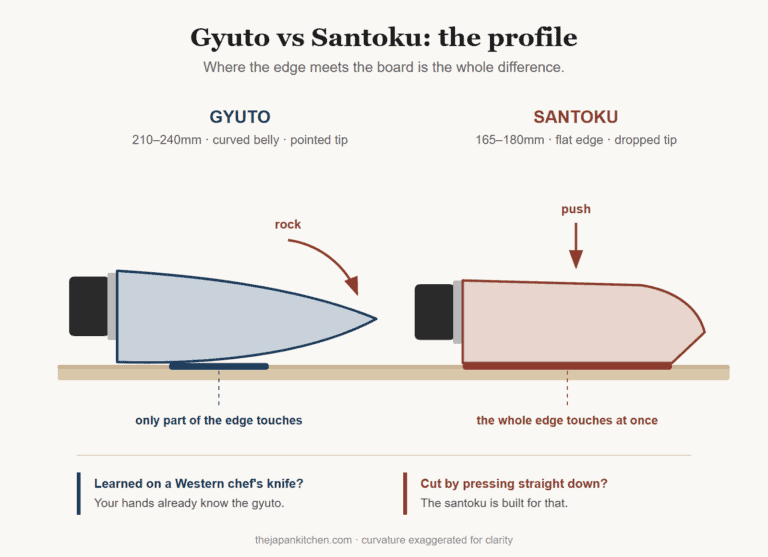
The gyuto-versus-santoku question comes up constantly, and the real difference is your cutting motion. A gyuto has a curved belly, so you can rock the blade against the board. A santoku is flatter and wants a push-and-lift. If you learned to cook watching people rock a chef’s knife, your hands already know the gyuto.
Full comparison: Santoku vs Gyuto
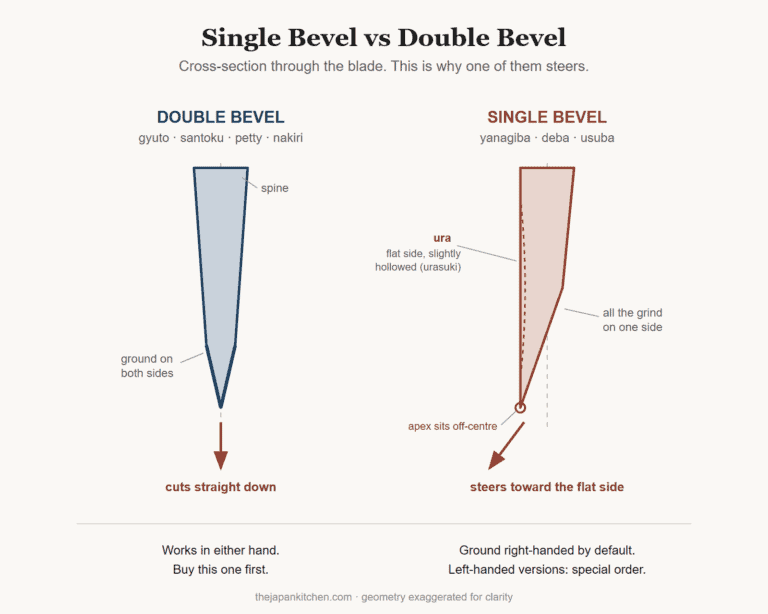
Skip single-bevel knives for now. A yanagiba or deba is ground on one side only, which produces an unbelievably clean cut on fish and makes the blade steer sideways in everything else. They are also handed — ground right-handed by default, with left-handed versions usually made to order.
They are wonderful tools. They are the third knife you buy, not the first. Why they steer, with a cross-section
Decision 2: Stainless or carbon?
This is where most of the marketing noise lives, and it is simpler than it sounds.
Carbon steel takes a sharper edge and sharpens faster when it dulls. It also rusts — not “might eventually,” but visibly within a day if you leave it wet. You dry it after every use. Every time.
Stainless does not do that. Modern Japanese stainless gets plenty sharp for home cooking. You give up a little at the very top of the edge and you get to be a normal person about the washing up.
The trade-off nobody states plainly
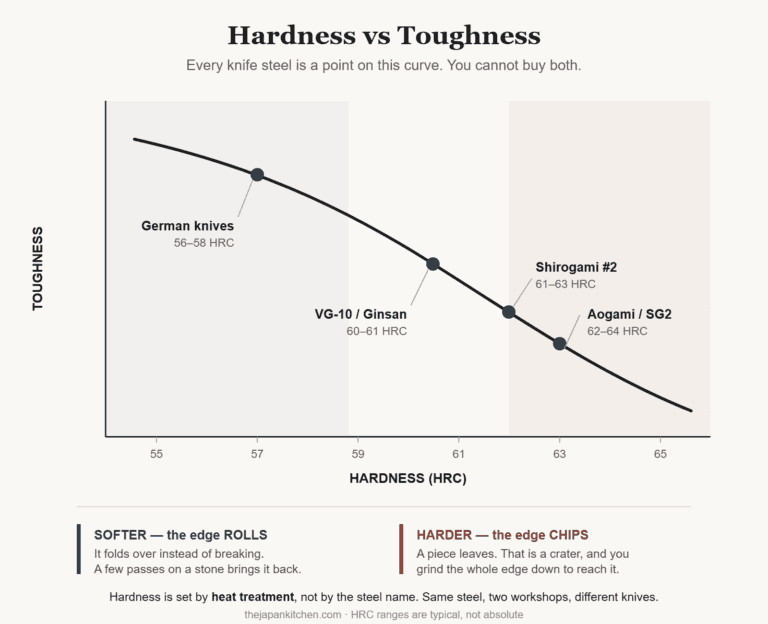
Hardness is not a quality score. It is a position on a curve.
A harder blade resists deformation, so the edge stays where you put it. That is edge retention. But the same property means the steel cannot bend to absorb a shock — so when it meets a bone, a frozen edge, or a ceramic plate, it chips instead of rolling.
Softer steel does the opposite. The edge folds over instead of breaking. You can straighten it. It just happens sooner.
German knives typically run around 56–58 HRC and Japanese knives around 60–63. That is the whole behavioural difference between the two traditions, in one number.
So if someone in your house puts knives in the dishwasher, or cuts on a glass board, buy softer steel. Not because you do not deserve nice things — because a 64 HRC blade will lose a piece of its edge and you will be angry.
Which steel does what, and why the workshop matters more than the alloy: Japanese Knife Steel Explained
Decision 3: How the blade is built
You will see these words on product pages. Here is what they change.
Kasumi — a hard steel core forge-welded to a softer iron jacket. The hard part cuts, the soft part absorbs shock and makes sharpening easier.
San-mai — three layers. Hard core, soft cladding both sides. Same idea, common on double-bevel knives.
Honyaki — a single piece of high-carbon steel, differentially hardened. Extremely difficult to make, extremely expensive, and it can crack during heat treatment. It is the most prestigious construction. For home cooking it is not a better knife. It is a more impressive one.
Damascus — the rippling pattern. Here is the part product pages leave out: on almost all kitchen knives the pattern is in the cladding, not the cutting edge. It is decoration layered over a core that does the actual work. A damascus VG-10 knife cuts exactly like a plain VG-10 knife.
Buy it because you like looking at it. That is a fine reason. Just do not pay extra thinking it cuts better.
Kurouchi — the black forge scale left on the blade. Rustic, usually on cheaper knives, slightly helpful against rust on the part it covers. It wears off over years.
Handles
Wa handles are the Japanese style — octagonal, D-shaped, or oval, usually wood, friction-fit onto the tang. Light, which pushes the balance forward toward the blade. Replaceable when they wear out.
Yo handles are Western style: riveted, heavier, with a bolster. Familiar if you have used European knives.
Both of my Japanese knives have yo handles, so I cannot tell you from experience how a wa handle changes a long prep session. What I can say is that the riveted Western handle is the one most people already know, and it is not a downgrade — plenty of excellent Japanese knives ship with it.
Neither style is better. Wa is lighter and easier to replace. Yo is more familiar and usually more water-resistant at the joint.
Where it was made
Regional names carry real meaning, and they are also used loosely in marketing.
Sakai (Osaka) — the traditional centre for professional single-bevel knives. Production is split across specialists: one workshop forges, another sharpens, another fits the handle.
Seki (Gifu) — sword-making heritage, now the volume centre. Many well-known export brands come from here.
Echizen (Fukui) — traditional hand forging, still a working craft cluster. Also home to Takefu Special Steel, which developed SG2 and brought it to market in 1991.
Tosa (Kochi) — rustic, often kurouchi-finished, descended from farm tool making. Frequently the best value.
Tsubame-Sanjo (Niigata) — a broad metalworking region covering knives, tableware and hand tools. Comfortable with modern steels and methods.
A warning worth having. “Japanese-style” is not “made in Japan.” There are knives on major marketplaces with Japanese-sounding brand names, Japanese aesthetics, and manufacturing somewhere else entirely. Check for an explicit country of manufacture. “Japanese steel” and “made in Japan” are different claims — steel can be imported and the knife made anywhere.
More on what each region actually makes: Japanese Knife Regions
What things cost
Taking a 210mm gyuto as the reference, here is roughly how the market lays out for a buyer outside Japan.
| Range | What you get |
|---|---|
| $45–80 | Factory stainless at lower hardness. Genuinely made in Japan, no hand finishing |
| $80–150 | The real entry point. VG-10, machine-finished, no serious weaknesses |
| $150–300 | Where most first serious purchases should land |
| $300–500 | Named makers, hand finishing, premium steels — SG2, Aogami Super |
| $500+ | Craft, rarity, and the maker’s name |
Some anchors, so the ranges mean something. A Tojiro DP in VG-10 sits around $100 and is the knife most people should probably buy first. Mid-range VG-10 gyutos cluster between $130 and $200. Past $380 you are into hand-finished work from named workshops, and specialist makers run well beyond $700.
The honest note about the top of that table: past roughly $300 you are mostly buying craftsmanship, finish, and the story of who made it. The cutting improvement from $300 to $900 is small and gets smaller. That is not an argument against buying one. It is an argument against expecting the price to show up in your onions.
And the honest note about the bottom. A $50 Japanese gyuto is a real knife made in Japan. It is softer stainless with a factory edge, which means it will not hold an edge the way this page describes and it will also survive treatment that would chip something harder. If that is your budget, buy it — just calibrate what you are getting.
What I use, and what that has taught me
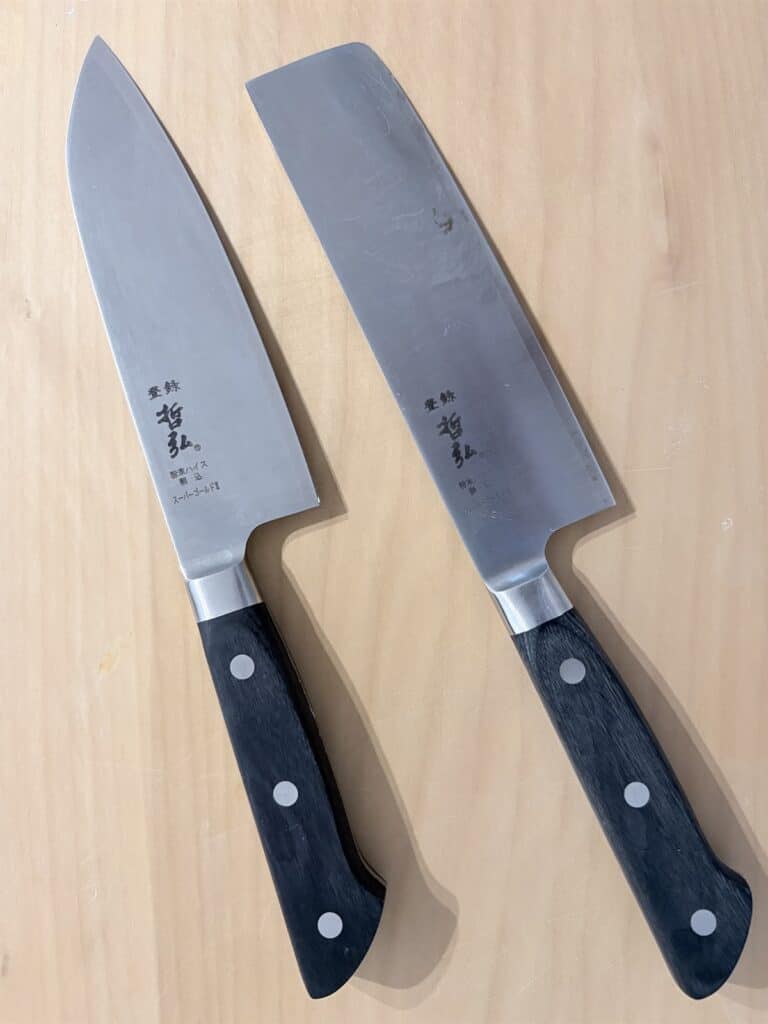
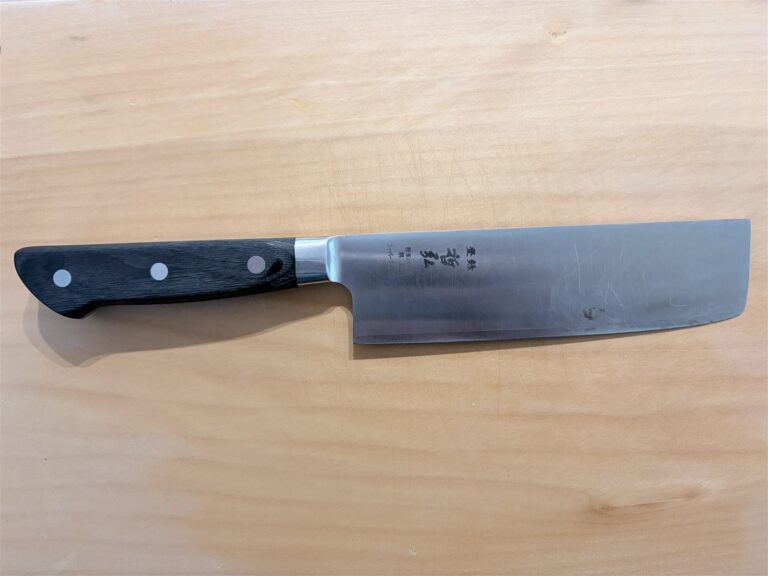
Two knives from a workshop in Sanjo, both in SG2, bought 2 years ago. A nakiri and a santoku.

The nakiri does most of the work. Two years of vegetable prep on one edge and it is only now starting to feel dull. The maker’s mark is wearing off the blade face from handling. That is what good edge retention looks like when you stop reading spec sheets and start counting months.
I still have not sharpened it, because I know SG2 is slow on a stone and I keep putting the job off. That is the honest cost of high-hardness steel: a long stretch of not thinking about the edge, followed by a session you are not looking forward to.
The santoku still looks new, and that is not neglect. For everyday work I use a cheap stainless santoku. The SG2 one comes out for the cuts the cheap knife struggles with — thick chicken, skin, anything a dull edge would tear. Premium steel did not become my default. It became a specialist.
It has also cut me. Not through bad technique, but because a blade that passes through a carrot with no resistance passes through a finger the same way, with no moment of feedback in between. The standard line is that a sharp knife is safer than a dull one. That is true about force and not true about consequences, and only the first half gets said.
Before you buy: the part that comes after
A Japanese knife is not a finished purchase. It is a thing you maintain.
You need a whetstone. Pull-through sharpeners are built for softer Western steel at a steeper angle, and they will reshape a Japanese edge into something blunter every time you use one.
You need the right board. Wood or soft plastic. Not glass, not stone, not ceramic. Bamboo deserves a specific mention, because the defence of it is a good example of a misleading specification: bamboo’s Janka hardness is around 1,380 lbf against roughly 1,450 for hard maple, so on paper it is softer. That is the number board makers quote. It is also not the number that matters — bamboo is a grass, and it accumulates silica in its fibres. Hardness measures denting. Silica measures abrasion. Your edge only cares about the second one.
I use a ginkgo board. Ginkgo is one of the traditional Japanese choices along with hinoki and honoki — soft enough to be kind to an edge, with enough spring that the knife does not jar on contact. It is barely mentioned in English-language advice, which tends to stop at hinoki.
You need the habit of washing and drying by hand, immediately. Dishwashers ruin these knives through heat, detergent, and knocking against other items.
None of this is difficult. It is about fifteen seconds per use. But it is not optional, and it is better to know before you spend the money: 7 Mistakes That Ruin a Japanese Knife
Which one should you buy?
| If you… | Get | Why |
|---|---|---|
| Are buying your first Japanese knife | 210mm gyuto, stainless (VG-10 or Ginsan) | Forgiving, versatile, hard to regret |
| Have a small kitchen or small hands | 165–180mm santoku | Same job, less blade to manage |
| Cook mostly vegetables | Nakiri | Nothing else is as good at it |
| Already own a chef’s knife you like | 150mm petty | Fills the gap you actually have |
| Share the kitchen with someone careless | Softer stainless, ~58–60 HRC | Fewer chips, fewer arguments |
| Will genuinely dry it every time | Carbon (shirogami or aogami) | The best edge available, if you earn it |
| Break down whole fish | Deba, single bevel | The only right tool |
Frequently asked
Is a Japanese knife worth it over a German one?
If you hand-wash and use a wood board, yes — a sharper edge that lasts longer. If your knives go in the dishwasher, no. A German knife survives that and a Japanese one does not. It is about your habits, not your cooking level.
Do I need a whole set?
No. Sets exist because they are easier to sell. Most home cooks use one main knife and a petty, and everything else in the block gathers dust. Buy one good knife instead of six mediocre ones.
How often do I sharpen it?
Depends on use, board, and steel. For home cooking, every few months on a whetstone is a rough guide — though as above, mine went two years before I noticed. You sharpen when it stops cutting well, and you learn to feel that.
Can I take a knife home from Japan in my luggage?
Yes — in checked baggage, never carry-on. There is more to it, including tax-free procedure and how shops pack knives for travel.
Related: Japanese Knife Steel Explained · Santoku vs Gyuto · Single Bevel vs Double Bevel · Japanese Knife Regions · 7 Mistakes That Ruin a Japanese Knife
Last updated: 15th August, 2026. Found something wrong? Tell me — corrections get published.