Japanese Knife Regions: Where Your Knife Was Actually Made
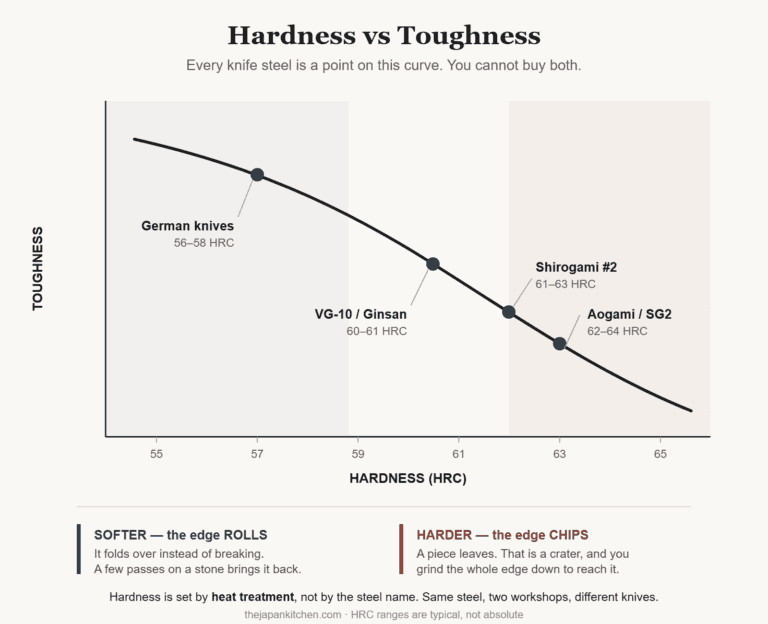
If you’ve read anything about Japanese knife steel, you’ve probably arrived at an uncomfortable conclusion: the steel name doesn’t tell you whether the knife is good. Two workshops can take the same VG-10 and produce meaningfully different blades, because hardness is set by heat treatment, not by the alloy. The full explanation is here.
So what does predict quality?
The workshop. And in Japan, workshops cluster by region — each with its own history, its own specialities, and its own way of working. Japanese knife regions are the closest thing this category has to a useful shorthand.
Here’s what the names actually mean.
First, the thing that confuses everybody
The brand on the blade is often not the person who forged it.
This is standard practice, not a scandal, and it trips up almost every foreign buyer.
In the traditional system, making a knife is at least three jobs. One workshop forges the blade. A second grinds and sharpens it. A third fits the handle. A fourth party — a retailer or a brand — puts their name on the finished thing and sells it.
So when you buy a knife stamped with a shop’s name, you may be buying the work of a forger whose name appears nowhere. That’s not deception. It’s how the trade has been organised for a long time, and the shop is staking its reputation on choosing well.
What it means practically: a brand name tells you who selected and finished the knife. The region tells you where the craft tradition it came from lives. Both are useful. Neither is the whole story.
The five Japanese knife regions worth knowing
Sakai (Osaka)
The centre of professional Japanese knife-making, especially single-bevel knives.
Sakai’s speciality is the division of labour described above, taken further than anywhere else. Forging, sharpening, and handle-fitting are separate trades practised by separate specialists, and the coordination between them is itself a skill.
What you’d buy from Sakai: a yanagiba, a deba, an usuba — the single-bevel knives used in professional Japanese kitchens. Sakai dominates this category, and if you’re serious about single-bevel work, this is where the depth is.
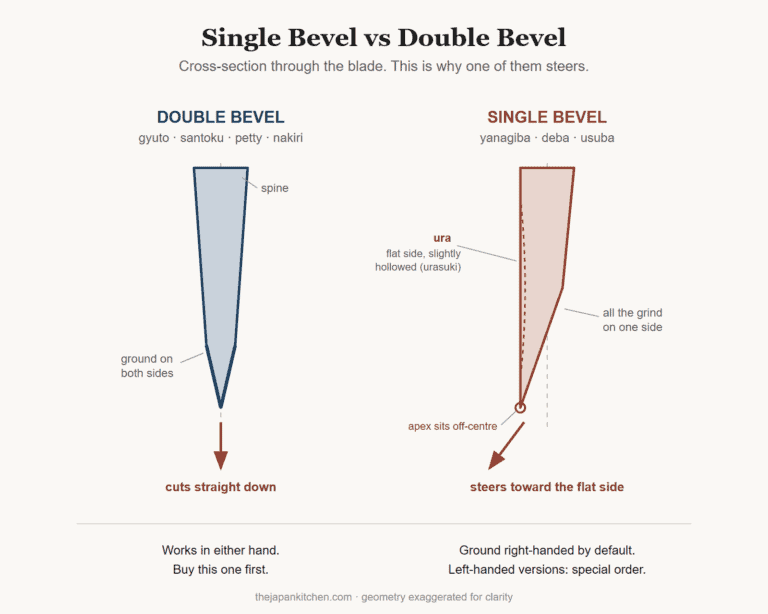
What to know: professional single-bevel knives are handed, expensive, and demand a sharpening skill most home cooks don’t have. Before you buy one, read single bevel vs double bevel.
Seki (Gifu)
Centuries of swordmaking heritage, now the volume centre of Japanese cutlery.
Seki is where scale lives. Modern factory production sits alongside traditional workshops, and a large share of the Japanese knives exported worldwide come from here. Several of the brand names a Western buyer would recognise are Seki operations.
What you’d buy from Seki: double-bevel kitchen knives at every price point, with consistent quality control and reliable availability. If you want a knife you can actually get, replace, and find spare parts for, this is the practical answer.
What to know: “made in Seki” spans a wide range — from serious hand-finished work to high-volume factory output. The region name alone doesn’t narrow the price bracket.
Echizen (Fukui)
Traditional hand forging, still practised as a living craft cluster rather than a heritage exhibit.
Echizen is known for thin, hand-forged blades and for a cooperative model where multiple independent smiths work in proximity.
There’s a detail here worth pausing on. Echizen is also home to Takefu Special Steel, founded in 1954, which developed SG2 — the powdered stainless used in high-end knives — and brought it to market in 1991.
Which produces a neat illustration of everything above: the steel can be made in one region and the knife forged in another. My own SG2 knives were made in Sanjo, several hundred kilometers away. The steel name told me nothing about where the knife came from — exactly as it shouldn’t.
Tosa (Kochi)
Free-forged, rustic, and usually the best value per yen in Japan.
Tosa’s tradition descends from farm and forestry tools rather than from swords or professional kitchens. The knives reflect that: often finished in kurouchi — the black forge scale left on the blade — with less cosmetic refinement and more attention to the working edge.
What you’d buy from Tosa: a hard-working double-bevel knife that performs above its price and looks like it came out of a forge. Popular with people who want performance and don’t need polish.
What to know: the finish is deliberately rough. If you want a mirror-polished blade, this isn’t the region. The black scale wears off over years of use, which some people like and some don’t.
Tsubame-Sanjo (Niigata)
A broad metalworking region rather than a knife speciality — and the one I have on my own counter.
Tsubame and Sanjo are adjacent cities with complementary traditions: Tsubame for metal tableware and finishing, Sanjo for blades and hand tools. Together they form one of Japan’s densest concentrations of metalworking capability, covering everything from kitchen knives to industrial components.
What you’d buy from Sanjo: modern, well-made double-bevel kitchen knives, including work in contemporary steels. The region is comfortable with powdered metallurgy and current manufacturing methods in a way that some more tradition-bound areas are not.
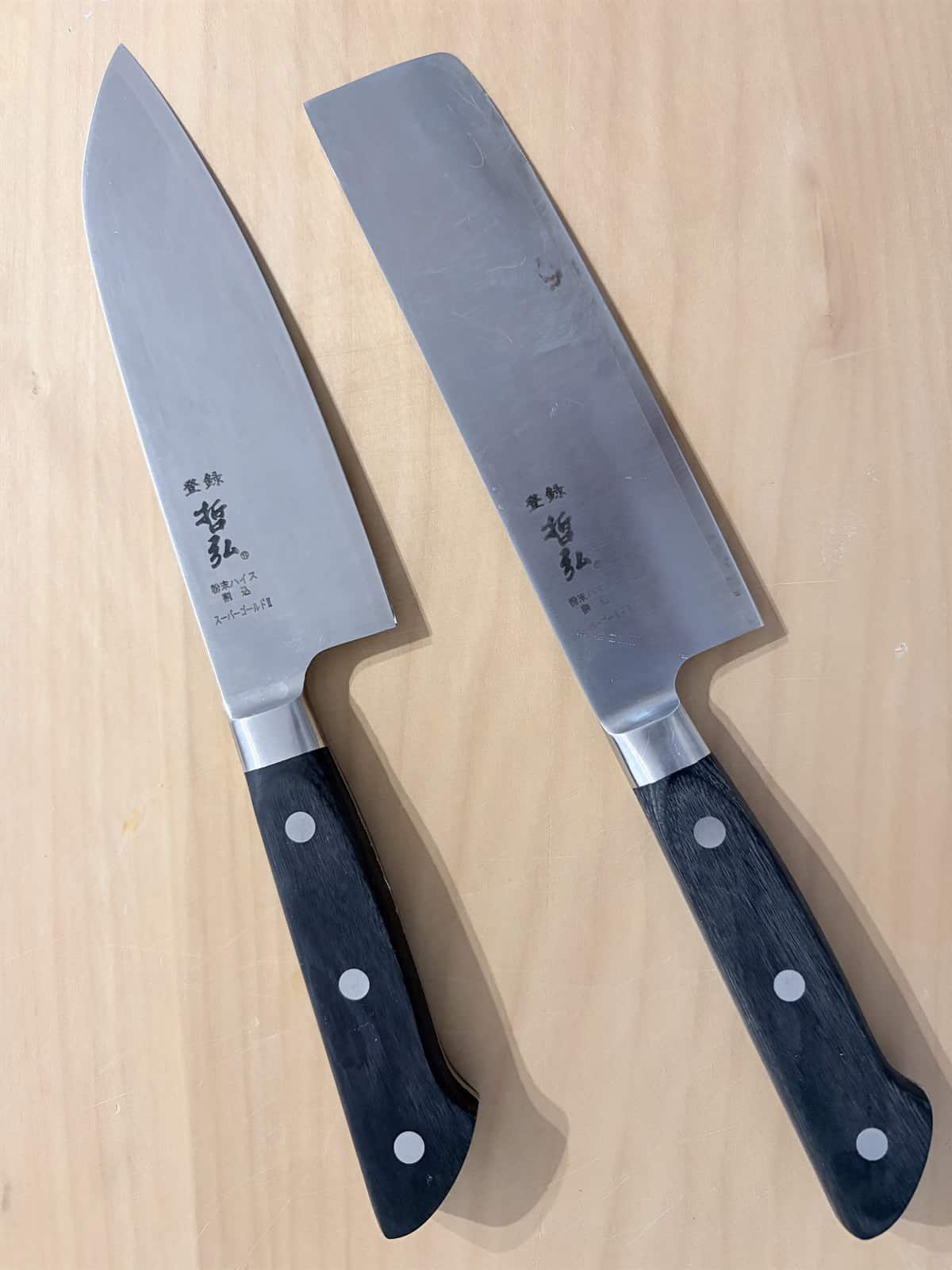
What I own: a santoku and a nakiri in SG2 from a Sanjo workshop, in daily use for a year.
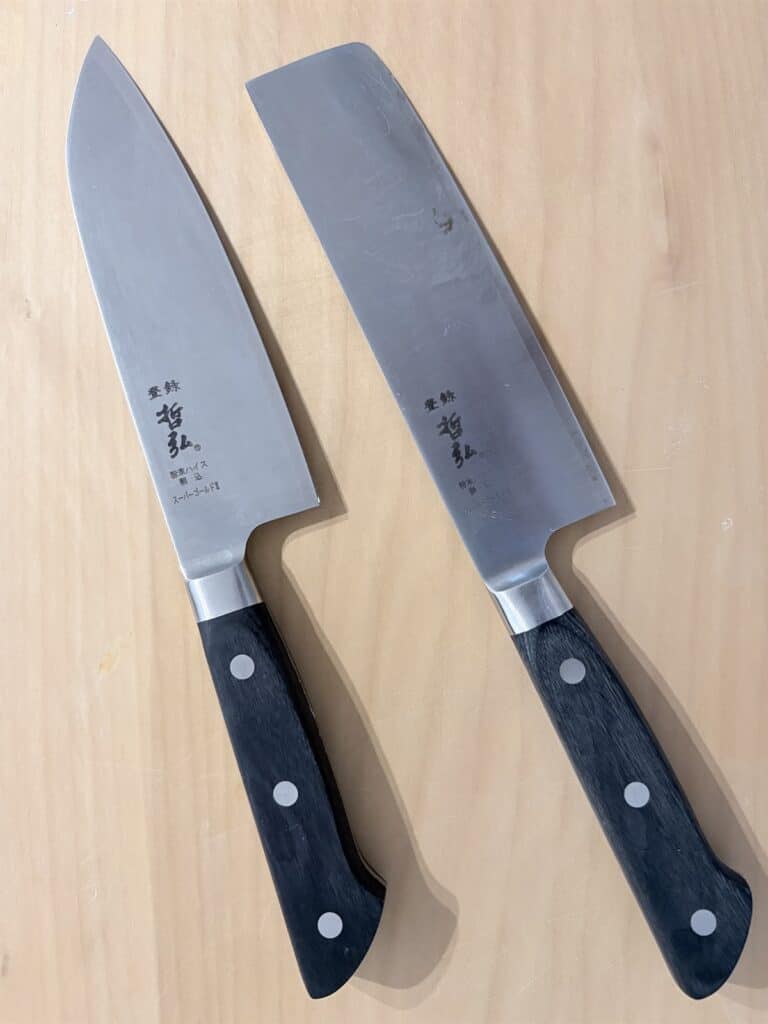
The steel came from one region, the knives from another.
They’re the reason I have opinions about high-hardness steel — including the unflattering ones. Those are here.
What to actually do with this
Honestly? Not much, at the point of purchase.
Region is useful for narrowing a category — if you want a single-bevel yanagiba, Sakai is where the depth is; if you want value with a rough finish, look at Tosa. It is not useful as a quality ranking. There are excellent and mediocre knives from every region on this page.
What region is good for is the question underneath. When a listing tells you a knife is “Japanese steel” but never names a region, a city, or a workshop, that vagueness is information. A knife actually made in Sakai or Seki will say so, because the maker considers it worth saying.
The warning worth repeating
“Japanese-style” is not “made in Japan.” “Japanese steel” is not “made in Japan” either.
Steel can be exported and a knife assembled anywhere. There are knives on international marketplaces with Japanese-sounding brand names, Japanese design cues, and manufacturing somewhere else entirely.
Some of them are perfectly good knives. They’re just not the thing you thought you were buying, and the listing is usually worded to let you make that mistake yourself.
Look for an explicit country of manufacture. If it isn’t there, assume it isn’t Japan.
Frequently asked
Is one region better than the others?
No. They specialise differently. Sakai for professional single-bevel, Seki for consistent volume production, Echizen and Tosa for hand-forged work at different price points, Sanjo for modern manufacturing. Pick by what you want, not by ranking.
Does the region affect the price?
Less than the amount of hand work does. A hand-forged, hand-finished knife costs more than a factory one from the same region.
Should I buy directly from the region?
Only if you’re travelling there. Otherwise a good retailer does the selection work for you, which is much of what you’re paying them for.
How do I find out where a specific knife was made?
Ask the seller. A shop that knows will tell you the region and often the workshop. A shop that doesn’t know is telling you something too.
Related: Japanese Knife Steel Explained
Last updated: 15th August, 2026. If something here is wrong, tell me and I’ll fix it with a note on what changed.