Japanese cutting board in ginkgo after two years of daily use
There are no affiliate links in this article — I have no relationship with anyone who sells this board. How this site makes money.
I have used the same japanese cutting board almost every day for two years. It is ginkgo, 40 by 25 centimetres, and 2.8cm thick — about 15.7 by 9.8 inches, and a shade over an inch deep.
In those two years I have never oiled it. I have never had it planed flat. I wash it under the tap, stand it on its edge, and that is the whole routine.
Every English-language guide to wooden boards I have read says to oil it monthly. I want to explain why that advice did not apply here, because the reason is not “Japanese boards are different.” It is narrower than that, and more useful.
What a japanese cutting board is made of
Mine is ginkgo — icho in Japanese, the same tree that lines streets all over Tokyo and drops those famously unpleasant nuts in autumn.
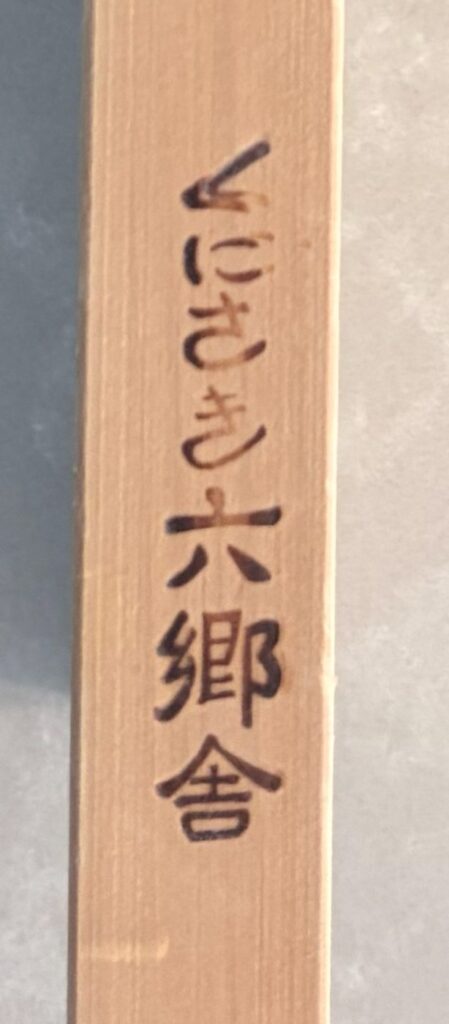
It was made by Kunisaki Rokugosha, a workshop on the Kunisaki peninsula in Oita, down in Kyushu. The name and the wood are burned into the edge of the board, which is how I can tell you this rather than repeating a product listing.
Ginkgo is one of the traditional Japanese board woods, along with hinoki (cypress) and ho (magnolia). All three are soft. That sounds like a flaw and is the entire point: a soft board gives slightly under the edge instead of stopping it dead. The maker’s own claim is that the wood’s elasticity is easy on the blade and helps a knife stay sharp longer.
Ginkgo is the one that barely appears in English-language advice, which tends to name hinoki and stop there. I do not think that is because it is worse. I think it is because hinoki is the word that made it into English.
The rule that did not apply
Here is the standard instruction, and you have read it too: a wooden board needs food-grade mineral oil, wiped on and left to soak in, every month or so. Skip it and the wood dries out, cracks, and starts absorbing everything you cut on it.
That instruction assumes a bare board.
Mine did not arrive bare. The maker treats it before it ships, and they are specific about what that means: a blend of edible oils — sunflower, thistle, soy, linseed — worked into the wood and then dried slowly over time. They call it taisui kako, water-resistant processing. The claims they make for it are that the board resists mould, resists staining, and dries quickly.
So the oil is already in there. It went in at the workshop, under conditions I cannot reproduce with a rag at my sink.
Two years in: no cracks, no warp, no smell, no black patches. The surface has gone from pale to a light honey colour through the middle where I actually cut, which is what wood does.
Now the part I have to be careful about. The maker does not say “you never need to oil this.” They do not mention re-oiling at all — there is no care routine on their page in either direction. An absent instruction is not an instruction.
So I will tell you what two years without oil looks like, and you can see it in the photographs. I am not going to tell you it is the right policy at year five, because I have not got to year five.
The two faces
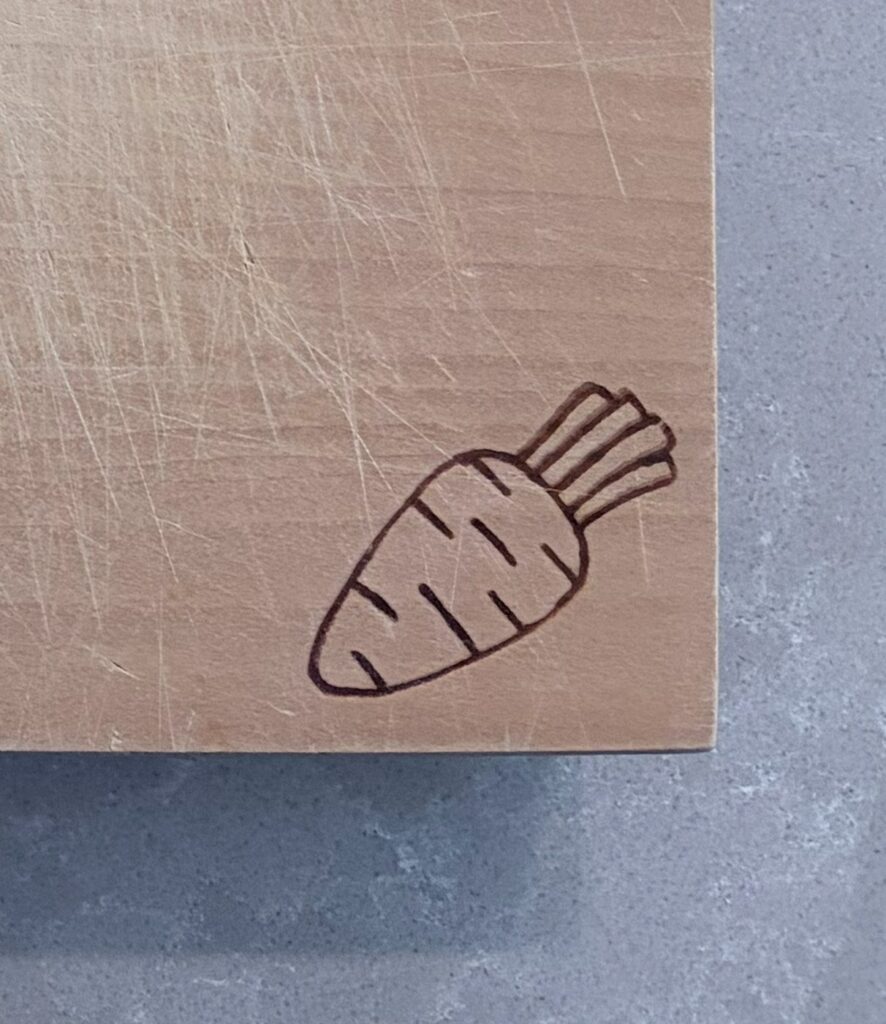
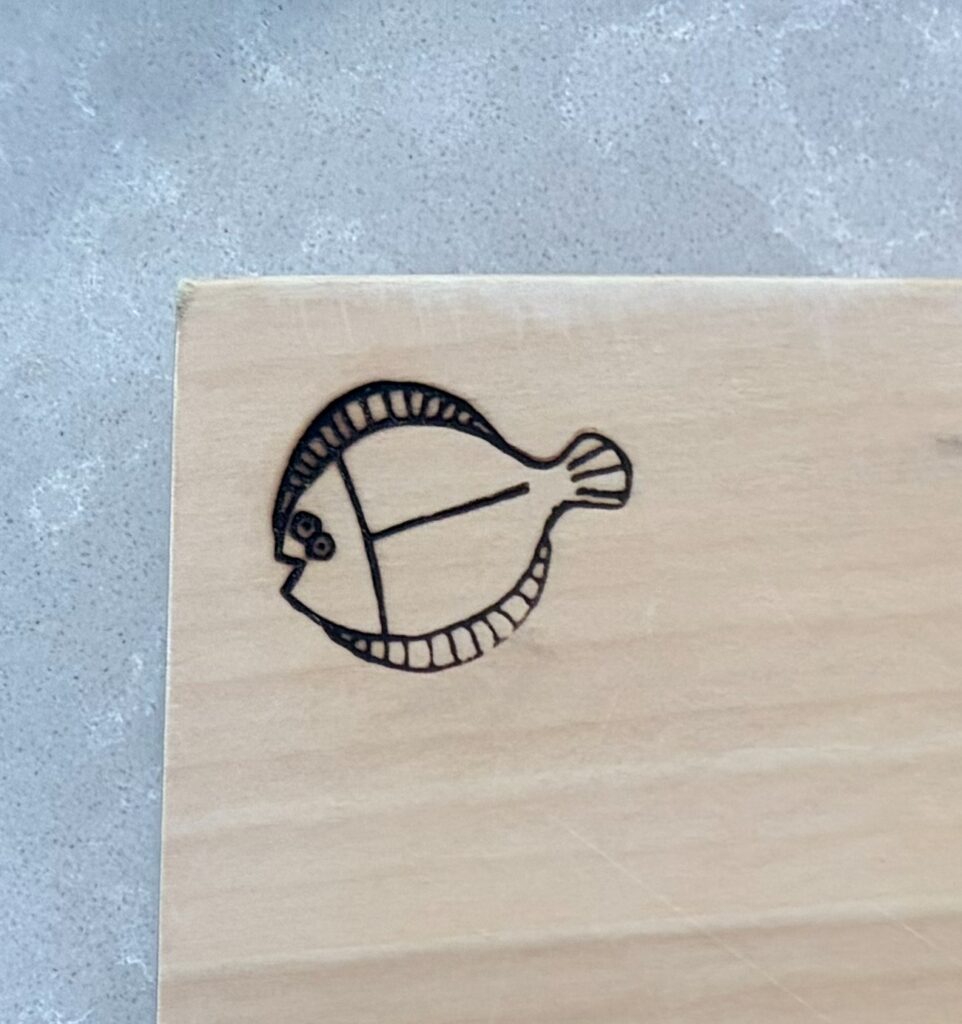
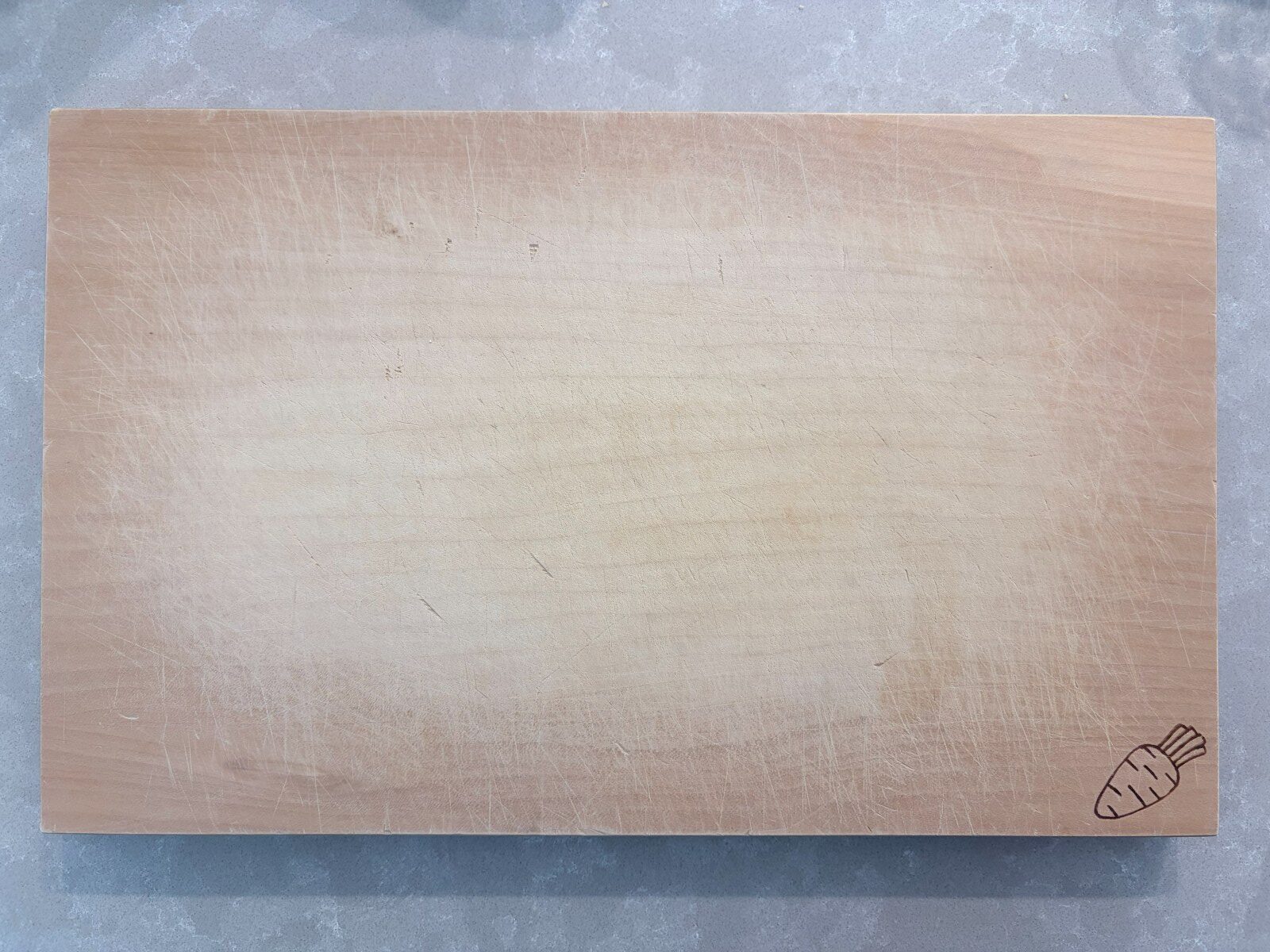
There is a small mark burned into one corner of the board. It is a root vegetable — a carrot, drawn with the root end trailing off.
Turn the board over and there is a different mark, in the opposite corner. It is a fish.
Two faces, two marks, one board.
Western food-safety advice on this question is settled and it never varies: buy two boards. Keep a separate one for raw meat, ideally in a different colour, and never let them meet. Colour-coded sets exist for exactly this reason.
The answer sitting in my kitchen is one board with two sides, and a picture on each side telling you which is which.
I use it the way it is drawn. Vegetables go on the carrot face. Meat goes on the fish face. The vegetable face gets rinsed and stood up to dry; the fish face gets detergent.
What two years of one face looks like
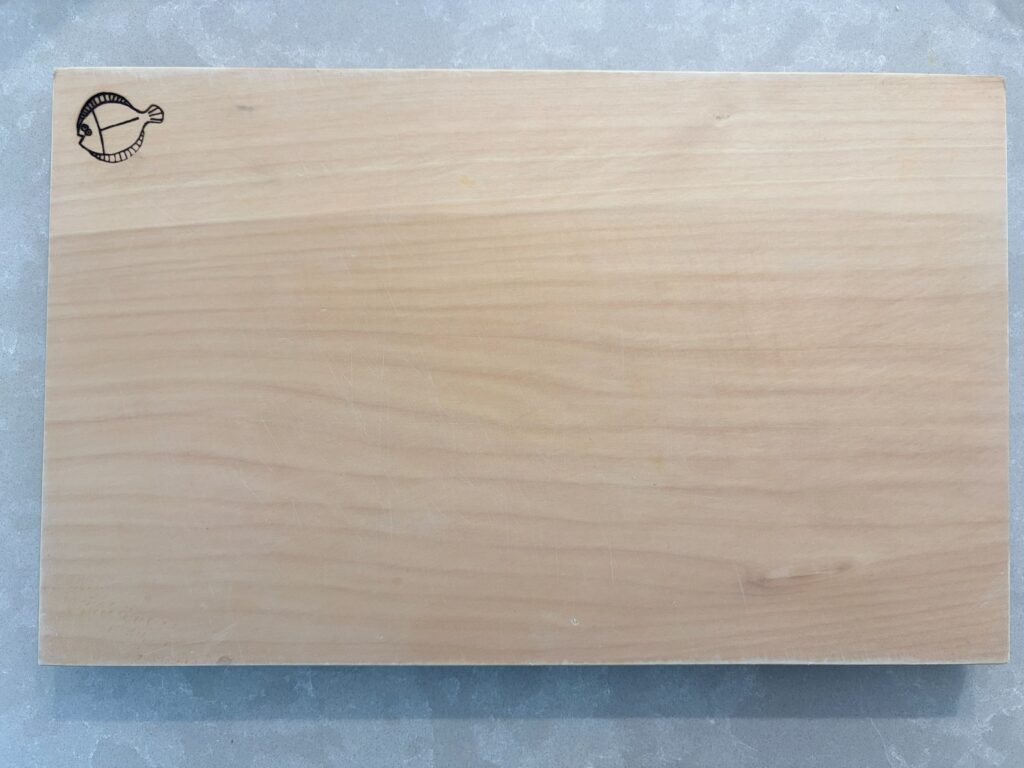
This is the part I did not expect to be interesting.
The carrot face is covered. Two years of scars crossing each other in every direction, a yellowed patch through the middle where the blade lands most often, a few darker specks that will not wash out.
The fish face looks like it left the workshop last week. Pale, flat, clean grain, a handful of shallow marks and nothing else.
Same board. Same two years.
That is not a fact about ginkgo and it is not a fact about the maker. It is a fact about me. I cut vegetables constantly and raw meat rarely, and the board has been quietly keeping score the whole time.
If you are trying to decide whether you need a dedicated meat board, go and look at the one you already own. The wear will tell you how much raw protein actually touches it, which is probably not the number you would have guessed.
Standing it up
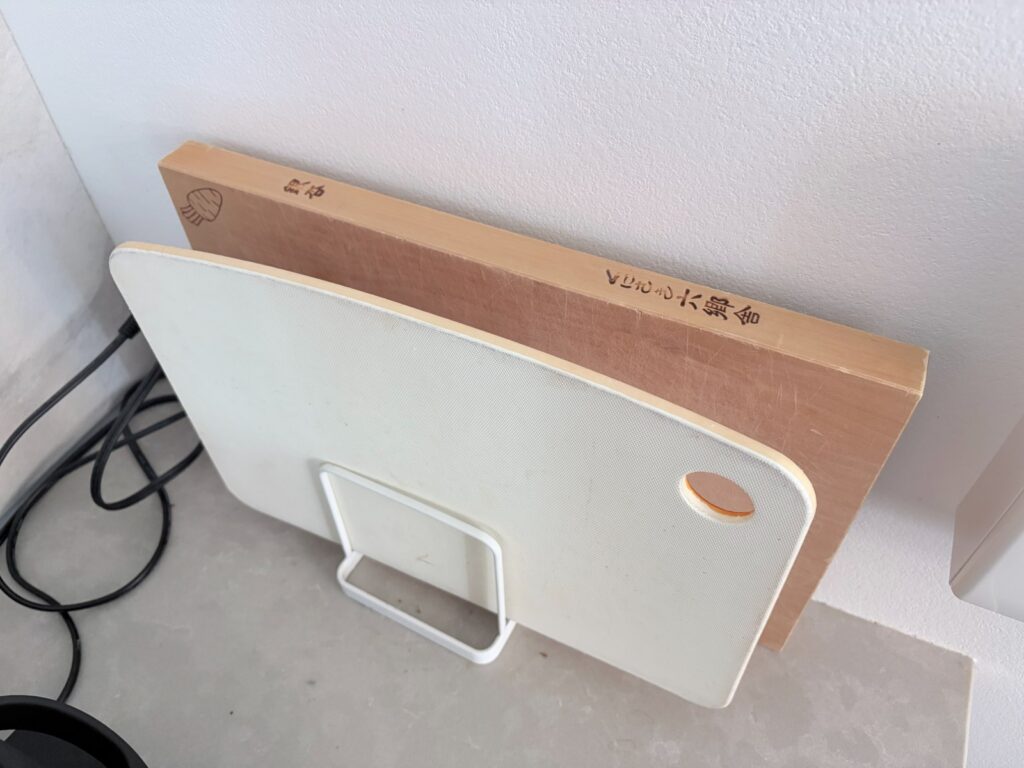
The routine, in full:
Vegetables. Rinse under the tap, wipe, stand it on its long edge against the wall. That is it.
Meat, or fish, or anything that leaves a film. Detergent and a sponge, both faces, then stand it up.
The standing-up is not decoration. A wet board lying flat on a counter dries on one side only, and the trapped side is where boards go black. This is the one place the maker’s “dries quickly” claim earns its keep — the board has to dry faster than things can grow in it, and mine does, on edge, in an ordinary kitchen with no special ventilation.
I have never had it planed. Japanese board makers will resurface a board, shaving off the scarred layer to give you a flat face again, and at some point I will probably look into that. Two years has not made it necessary. The scars are deep enough to see and not deep enough to hold anything a sponge cannot reach.
What it does to a knife
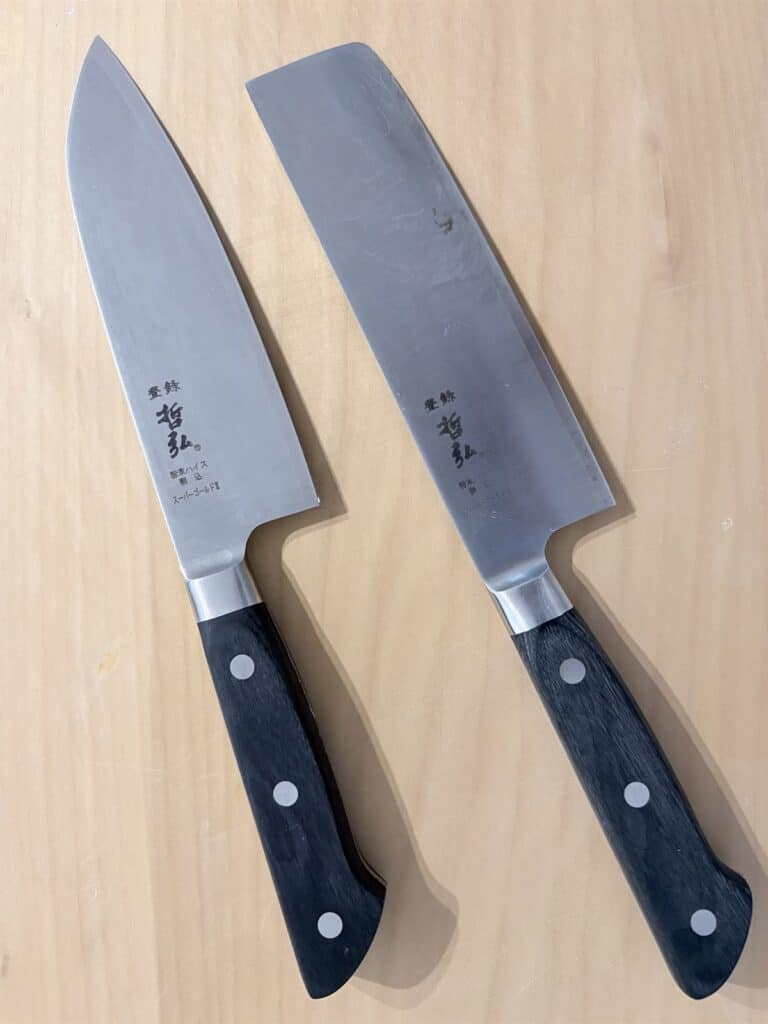
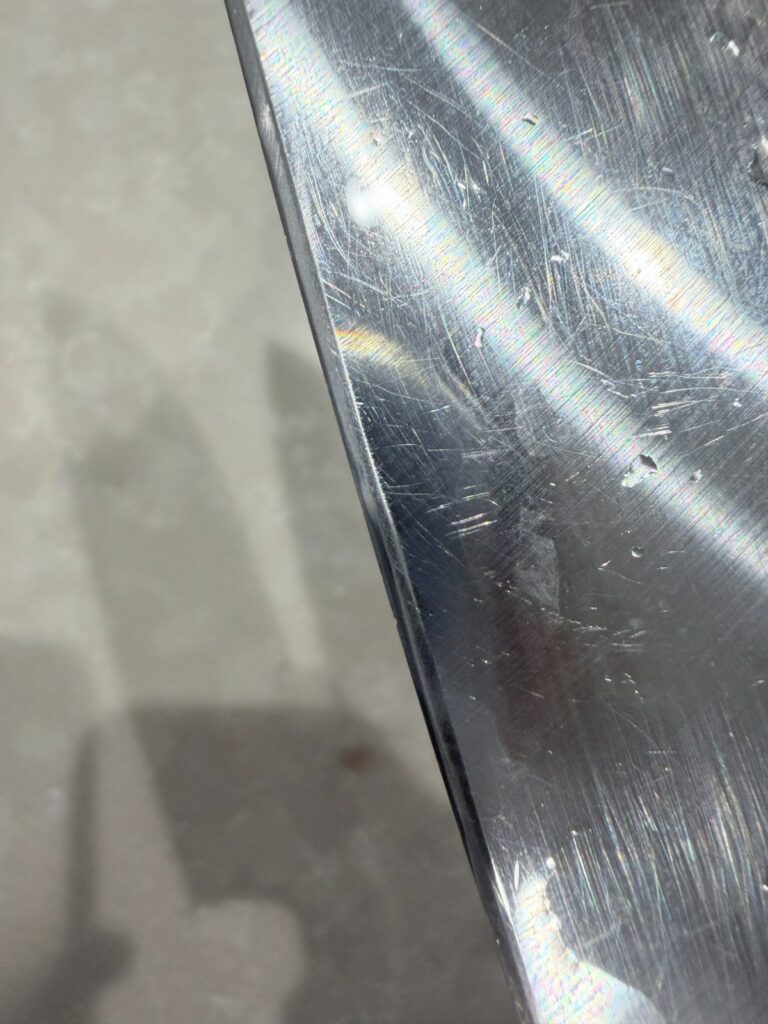
The two knives that live on this board are an SG2 santoku and an SG2 nakiri, and I have had them exactly as long — two years, and I have not sharpened either one.
I want to be straight about what that does and does not prove. SG2 is a powder steel that holds an edge a long time on its own merits, and I am one person with one board. I cannot separate the wood’s contribution from the steel’s.
What I can give you is the negative case, which is the one worth acting on anyway: a hard surface will wreck an edge, and quickly. Glass, stone, ceramic and bamboo all do it — bamboo especially, because it is a grass that packs silica into its fibres, and silica abrades steel regardless of what the hardness number on the marketing page says. That is one of the most common ways to ruin a good knife, and the rest of them are here.
If you have spent real money on a Japanese knife, the board is not an accessory. It is half of the cutting system. More on why the steel makes this matter: Japanese knife steel explained.
The dishwasher question
I should declare a bias. There is a German dishwasher built into this kitchen, and my default buying rule is blunt: if it cannot go in the dishwasher, it needs a reason.
Most of what I own passes that test. The things that do not are all in one category — objects where a dishwasher-safe version of the thing does not exist at all. A donabe is one. A Japanese iron pan is another. This board is the third.
For those three I gave up the convenience deliberately, knowing what I was giving up, in exchange for what the object actually does.
That is the honest test to run before you buy a wooden board. It is not “is wood better.” It is: are you going to wash this by hand, every time, for years? If the answer is no, buy a soft plastic board and put the money into the knife instead. A plastic board that gets cleaned properly beats a wooden board that gets resented.
How I got it, and what I am not going to tell you
This board came through furusato nozei, Japan’s hometown tax system, where you direct part of your residence tax to a municipality and receive a local product in return. The donation was ¥45,000, to Kunisaki city, in August 2024.
That figure is not the price of the board. It is what I redirected in tax, and the return gift is a fraction of it.
I can give you a real anchor instead. The same maker sells a smaller board — 37 by 22cm, 2.2cm thick — through a Kunisaki regional mail-order site for ¥7,500 in its standard grade and ¥9,300 in the premium one. Mine is larger in all three dimensions, so it sits above both of those.
I went looking for the actual number, and there is not one. My size is in their lineup — it is a standard product, not something special-ordered — but it carries no published price, not on the maker’s own site and not on the shop that carries the smaller ones. The only figure attached to it anywhere is the tax donation. So when I say I do not know what it costs, that is not me being coy. There is nothing to look up.
The gap between those two grades is worth understanding, because it is not about performance. The standard grade is sold with the caveat that it has small knots and grain variation. The premium grade is near knot-free and marketed as suitable for a gift. You are paying about twenty-four per cent more for a board with fewer knots in it. Nothing about how it cuts changes. If yours is going to end up looking like the first photograph inside two years — and it is — buy the cheaper one.
So I am not going to tell you this board is worth the money, because I did not pay a price for it and I would be inventing the number. What I can tell you is what it looks like after two years of daily use, and that is what the photographs are for.
One more thing, before you get attached to it: I cannot find a way to have this board sent outside Japan. Neither the maker nor the shop that carries the smaller sizes lists an overseas shipping option.
So this is not a recommendation for an object. I could not sell you this one if I tried. It is a recommendation for a category, and for one question to ask about whatever board you can actually get.
So should you buy one?
Buy a soft wooden board if you own a Japanese knife, you will hand-wash it and stand it up to dry, and you want the edge to last. Ginkgo, hinoki or ho are all the right category. Ginkgo is the one you will have to go looking for in English.
Get one thick enough to stay put. Mine is 2.8cm and heavy enough that it does not slide or drum on the counter. Thin boards move, and a moving board is a safety problem before it is a comfort problem.
Check whether it is pre-treated before you buy oil for it. This is the whole point of this article. If the maker has already driven oil into the wood, the monthly ritual you read about online is solving a problem you do not have. If it is bare, then do it.
Do not buy one to look at. The carrot face of mine is scarred, yellowed and speckled, and that is what a working board looks like at two years. If that photograph puts you off, the board is not the problem — you want a serving board, which is a different object entirely.
Everything else about choosing the knife that goes with it is here: Japanese kitchen knives, a complete buyer’s guide.
Questions I get asked
Do I need to oil a japanese cutting board?
It depends entirely on whether yours arrived treated. Mine did — the maker soaks it in edible oils before it ships — and two years in it has not asked for anything. A bare, untreated board is a different object, and the standard mineral-oil advice applies to it.
Can I use detergent on a wooden board?
I do, on the meat face, every time. The board dries fast enough that it has never caused a problem. The step I would not skip is standing it on edge afterwards.
So should you buy one?
Not this one. You cannot buy it, so here is the version of the question you can actually act on: what do you look for in a board you can buy?
Buy a soft wooden board if you own a Japanese knife, you will hand-wash it and stand it up to dry, and you want the edge to last. Ginkgo, hinoki and ho are all the right category.
In English, that means hinoki in practice. Search for a Japanese cutting board in English and what comes back is Japanese cypress — several makers, several sizes, proper product pages, easy to buy. Ginkgo barely surfaces at all. I have never used a hinoki board and I am not going to tell you how one performs. What I can tell you is that it sits in the same family of soft, springy woods as mine, and it is the one that is actually in front of you.
Get one thick enough to stay put. Mine is 2.8cm and heavy enough that it does not slide or drum on the counter. Thin boards move, and a moving board is a safety problem before it is a comfort problem.
Check whether it is pre-treated before you buy oil for it. This is the whole point of this article, and it takes about thirty seconds. The listings tell you, if you read them instead of the review score.
I have seen hinoki boards sold with “not glued, not coated” stated plainly in the description. That is a bare board, and every word of the standard mineral-oil advice applies to it — buy the oil, do it monthly. Mine says the opposite in the maker’s own words: treated before shipping, with the oils named.
Two boards, the same family of wood, opposite instructions. Neither listing is being dishonest. They are simply not the same object, and the advice written for one of them has been copied onto the other for years. Find out which one you are holding before you buy a bottle of anything.
Do not buy one to look at. The carrot face of mine is scarred, yellowed and speckled, and that is what a working board looks like at two years. If that photograph puts you off, the board is not the problem — you want a serving board, which is a different object entirely.
Everything else about choosing the knife that goes with it is here: Japanese kitchen knives, a complete buyer’s guide.